More than 2.8-million-plus views, thanks to EASN's many readers!
Showing posts with label Hevelius 10 constellations. Show all posts

Wednesday, July 26, 2023

Hevelius Named Triangulum Minus Little Triangle Constellation in 1687


Summary: Johannes Hevelius introduced Triangulum Minus the Little Triangle constellation in 1687 as a smaller companion of existing constellation Triangulum.


Andromeda the Chained Maiden, with (lower right) Triangulum Majus and Triangulum Minus; Hevelius's depiction from perspective of outsider looking into celestial globe reverses actual east-west appearance of sky for Earth-based observer as insider looking outward at celestial globe; J. Hevelii, Firmamentum Sobiescianum (MDCXC [1690]), Fig. V: Public Domain, via ETH-Bibliothek e-rara

Seventeenth-century Polish astronomer Johannes Hevelius introduced Triangulum Minus the Little Triangle constellation in 1687 as a smaller companion for already existing triangular constellation Triangulum the Triangle.
Johannes Hevelius (Polish: Jan Heweliusz; Jan. 28, 1611-Jan. 28, 1687) introduced Triangulum Minus the Lesser Triangle constellation as one of 10 constellations that he had invented in Prodromus Astronomiae. The three-volume compendium consisted of the Prodromus; a star catalogue, Catalogus Stellarum Fixarum; and a star atlas, Firmamentum Sobiescianum sive Uranographia. Hevelius's death left the Prodromus Astronomiae unfinished and the catalogue and star atlas, which had been printed in 1687, unpublished. The astronomer-selenographer's wife, Polish astronomer Elisabeth Catherina Koopmann Hevelius (Polish: Elżbieta Koopman Heweliusz; Jan. 17, 1647–Dec. 22, 1693), finished the Prodromus and then published all three volumes in 1690 under the posthumous authorship of her husband.
Triangulum Minus appeared as the seventh of Hevelius's 10 newly created constellations in Chapter VIII, De Numero Aſteriſmorum & Stellarum, tum nonnullis Rebus animadverſione dignis, of section Tabulae Solares Novae ("New Solar Tables") in the Prodromus. The small triangle emerged from three new stars that he discovered in southeastern Triangulum the Triangle constellation. The new triangle's stars shone between Aries the Ram and Triangulum the Triangle, according to their discoverer.
"Triangulum Minus. Caeterùm; Triangulum minus, quod ex tribus novis Stellulis conſtat, etiam ex numero novorum meorum Siderum eſt; haud potuit ferè aliter denominari: cùm ſub altero Triangulo majori, & ſupra Caput Arietis ſplendeat," described Hevelius (page 117).
The forming of the new triangular constellation necessitated renaming the existing constellation. Hevelius retitled Triangulum as Triangulum Majus, as explained by English astronomy writer Ian Ridpath (born May 1, 1947) in his profile "Triangulum Minus the little triangle," included in Chapter Four: Obsolete Constellations of his Star Tales book (1988; revised and expanded, 2018) and posted on his eponymous website (www.ianridpath.com).

Aries the Ram, with Triangula pair (upper center), Majus and Minus, and Musca (Musca Borealis); Hevelius's depiction from perspective of outsider looking into celestial globe reverses actual east-west appearance of sky for Earth-based observer as insider looking outward at celestial globe; J. Hevelii, Firmamentum Sobiescianum (MDCXC [1690]), Fig. BB: Public Domain, via ETH-Bibliothek e-rara

Triangulum Minus neighbors with Aries the Ram and Triangulum Majus. The small celestial triangle brushes the Ram's northwestern borders and its constellatory parent's southeastern limits. A discarded constellation, Musca Borealis (Latin: "northern fly"), appears as an eastern neighbor, perched between northern Aries the Ram and southern Perseus the Hero, on two (Figures BB, W) of the three sky charts (BB, V, WW) on which Hevelius depicted Triangulum Minus.
The exclusion of Triangulum Minus from the list of 88 constellations approved in 1922 by the International Astronomical Union (IAU) rendered Hevelius's triangle obsolete. Its three starry components of 6 Trianguli (abbreviated 6 Tri; also known as ι Trianguli, Iota Trianguli, abbreviated ι Tri, Iota Tri), 10 Trianguli (10 Tri) and 12 Trianguli (12 Tri) were assigned to Triangulum the Triangle constellation.
Triangulum the Triangle, the constellation in which Triangulum Minus may be viewed as an asterism (Ancient Greek: ἀστερισμός, asterismós, “group of stars”), encompasses an area of 131.8 square degrees, which accounts for 0.320 percent of the sky, according to Ian Ridpath's table of constellations. Its area places Triangulum Minus as 78th in order of size among the 88 IAU-approved constellations.
Right ascension (abbreviated RA; symbol α) coordinates for Triangulum extend from 01 hours 31 minutes 27.9408 seconds to 02h 50m 39.9523s, according to the constellation boundary tables on the International Astronomical Union's website. In the equatorial coordinate system, right ascension identifies with terrestrial longitude.
Declination (abbreviated dec; symbol δ) coordinates for Triangulum stretch from plus 25.6050701 to plus 37.3470840. The equatorial coordinate system's declination associates with geographic latitude.
Constellation Triangulum offers full visibility to Earth-based observers occupying latitudes 90 degrees north and 52 degrees south. Partial visibility of the triangular constellation is available to stargazers stationed between latitudes 52 degrees south and 64 degrees south in the southern hemisphere (Ridpath, Constellations -- 2).
Triangulum the Triangle constellation numbers among 13 autumnal constellations listed by the American Association of Amateur Astronomers (AAAA) on The Constellation Home Page on the organization's website. Late autumn and early winter qualify for best viewing seasons of Triangulum the Triangle constellation in the northern hemisphere, according to science writer Kelly Kizer Whitt in "Triangulum the Triangle in northern skies," published Dec. 6, 2022, on the EarthSky website. December is the best month for observing Triangulum, according to James Miller in "Star Constellation Facts: Triangulum," posted July 15, 2016, on his website, Astronomy Trek.
Even though Hevelius's Triangulum Minus has been nullified as a constellation, the small triangle nevertheless remains as an asterism within its parent's territory. The Great Square of Pegasus the Winged Horse and Cassiopeia the Seated Queen function as finding aids for Triangulum, according to Kelly Kizer Whitt. Triangulum lies northeast of the Great Square of Pegasus and below distinctively w-shaped Cassiopeia. Triangulum Minus shines in southeastern Triangulum.

Perseus the Hero, with Triangula pair(lower center-right), Triangulum Majus and Triangulum Minus, and Musca (Musca Borelis); Hevelius's depiction from perspective of outsider looking into celestial globe reverses actual east-west appearance of sky for Earth-based observer as insider looking outward at celestial globe; J. Hevelii, Firmamentum Sobiescianum (MDCXC [1690]), Fig. W: Public Domain, via ETH-Bibliothek e-rara

Acknowledgment
My special thanks to talented artists and photographers/concerned organizations who make their fine images available on the internet.

Dedication
This post is dedicated to the memory of our beloved blue-eyed brother, Charles, who guided the creation of the Met Opera and Astronomy posts on Earth and Space News. We memorialized our brother in "Our Beloved Blue-Eyed Brother, Charles, With Whom We Are Well Pleased," published on Earth and Space News on Thursday, Nov. 18, 2021, an anniversary of our beloved father's death.

Image credits:
Andromeda the Chained Maiden, with (lower right) Triangulum Majus and Triangulum Minus; Hevelius's depiction from perspective of outsider looking into celestial globe reverses actual east-west appearance of sky for Earth-based observer as insider looking outward at celestial globe; J. Hevelii, Firmamentum Sobiescianum (MDCXC [1690]), Fig. V: Public Domain, via ETH-Bibliothek e-rara @ https://www.e-rara.ch/zut/content/zoom/133931
Aries the Ram, with Triangula pair (upper center), Majus and Minus, and Musca (Musca Borealis); Hevelius's depiction from perspective of outsider looking into celestial globe reverses actual east-west appearance of sky for Earth-based observer as insider looking outward at celestial globe; J. Hevelii, Firmamentum Sobiescianum (MDCXC [1690]), Fig. BB: Public Domain, via ETH-Bibliothek e-rara @ https://www.e-rara.ch/zut/content/zoom/133931
Perseus the Hero, with Triangula pair(lower center-right), Triangulum Majus and Triangulum Minus, and Musca (Musca Borelis); Hevelius's depiction from perspective of outsider looking into celestial globe reverses actual east-west appearance of sky for Earth-based observer as insider looking outward at celestial globe; J. Hevelii, Firmamentum Sobiescianum (MDCXC [1690]), Fig. W: Public Domain, via ETH-Bibliothek e-rara @ https://www.e-rara.ch/zut/content/zoom/133921

For further information:
The American Association of Amateur Astronomers. "The Autumn Constellations." The American Association of Amateur Astronomers > The Constellation Home Page.
Available @ http://www.astromax.org/con-page/con-fall.htm
Flaspoehler, Edward P., Jr. "The Constellation Triangulum -- The Triangle." The American Assocation of Amateur Astronomers > The Constellation Home Page > The Summer Constellations.
Available @ http://www.astromax.org/con-page/summer/sct-01.htm
Harper, David; and L. (Lynne) M. Stockman. "Triangulum Minor -- The Lesser Triangle. Unofficial Abbreviation: TMi. Genitive: Trianguli Minoris. Origin: Johannes Hevelius." Obliquity > Sky Eye > The Constellations > Extinct Constellations.
Available @ https://www.obliquity.com/skyeye/88const/TMi.html
Hevelii, Johannis. "Triangulum Minus. Caeterùm; Triangulum minus, quod ex tribus novis Stellulis conſtat, etiam ex numero novorum meorum Siderum eſt; haud potuit ferè aliter denominari: cùm ſub altero Triangulo majori, & ſupra Caput Arietis ſplendeat." Page 117. Prodromus Astronomiae cum Catalogo Fixarum, & Firmamentum Sobiescianum: Prodromus Astronomiae . . . Quibus additus est uterq[ue] Catalogus Stellarum Fixarum, tam major ad Annum 1660, quàm minor ad Annum completum 1700. Acceſſ Corollarii loco Tabula Motus Lunae Libratorii, Ad bina ſecula proximè ventura prolongata, brevi cum Deſcriptione, ejus ue uſu. Tabulae Solares Novae, pages 51-142. Caput VIII De Numero Aſteriſmorum & Stellarum, tum nonnullis Rebus animadverſione dignis," pages 108-124. Gedani [Gdansk]: Typis Johannis-Zachariae Stollii, M DC XC [1690].
Available via ETH-Bibliothek e-rara @ https://www.e-rara.ch/zut/content/zoom/133609
Available via National Digital Library Polona @ https://polona.pl/item-view/049ab5c8-5726-4a52-ad1b-48f3f475c4f2?page=73
Available via Google Books Read Free of Charge @ https://www.google.com/books/edition/JOHANNIS_HEVELII_PRODROMUS_ASTRONOMIAE/OEPatgAACAAJ?hl=en&gbpv=1&printsec=frontcover
Available via Linda Hall Library of Science, Engineering & Technology Catalog @ https://catalog.lindahall.org/discovery/delivery/01LINDAHALL_INST:LHL/1284873740005961
Hevelii, Johannis. "Triang. Minus." Page 304. Catalogus Stellarum Fixarum ad Annum Christi M DCC Completum. Pages 269-308. In: Prodromus Astronomiae . . . Quibus additus est uterq[ue] Catalogus Stellarum Fixarum, tam major ad Annum 1660, quàm minor ad Annum completum 1700. Acceſſ Corollarii loco Tabula Motus Lunae Libratorii, Ad bina ſecula proximè ventura prolongata, brevi cum Deſcriptione, ejus ue uſu. Gedani [Gdansk]: Typis Johannis-Zachariae Stollii, M DC XC [1690].
Available via ETH-Bibliothek e-rara @ https://www.e-rara.ch/zut/content/zoom/133800
Available via Google Books Read Free of Charge @ https://www.google.com/books/edition/JOHANNIS_HEVELII_PRODROMUS_ASTRONOMIAE/OEPatgAACAAJ?hl=en&gbpv=1&printsec=frontcover
Available via Linda Hall Library of Science, Engineering & Technology Catalog @ https://catalog.lindahall.org/discovery/delivery/01LINDAHALL_INST:LHL/1284873740005961
Hevelii, Johannis. "Triangulum Minus." Page 416. Machinae Coelestis. Liber Quartus, Rerum Uranicarum Observationes, Gedani. Gedani [Gdansk]: Simon Reiniger, M DC LXXIX [1679].
Available via Internet Archive @ https://archive.org/details/Machinacoelesti2Heve/page/416/mode/1up
Kaler, James B. (Jim). “6 TRI (6 Trianguli).” University of Illinois Astronomy Department > Star of the Week.
Available @ http://stars.astro.illinois.edu/sow/gammacas.html
Kaler, James B. (Jim). “Triangulum.” University of Illinois Astronomy Department > Star of the Week.
Available @ http://stars.astro.illinois.edu/sow/tri-t.html
Marriner, Derdriu. "Cassiopeia the Queen Constellation Is True Arrow to Andromeda Galaxy." Earth and Space News. Wednesday, Aug. 24, 2016.
Available @ https://earth-and-space-news.blogspot.com/2016/08/cassiopeia-queen-constellation-true.html
Marriner, Derdriu. "Five Star Circlet of Pisces Asterism Is Below Great Square of Pegasus." Earth and Space News. Wednesday, Oct. 11, 2017.
Available @ https://earth-and-space-news.blogspot.com/2017/10/five-star-circlet-of-pisces-asterism-is.html
Marriner, Derdriu. "Great Square of Pegasus Asterism Has Four Second Magnitude Stars." Earth and Space News. Wednesday, Oct. 4, 2017.
Available @ https://earth-and-space-news.blogspot.com/2017/10/great-square-of-pegasus-asterism-has.html
Marriner, Derdriu. "Hevelius Crater Parents Seven Satellites at West Oceanus Procellarum." Earth and Space News. Wednesday, Jan. 18, 2023.
Available @ https://earth-and-space-news.blogspot.com/2023/01/hevelius-crater-parents-seven.html
Marriner, Derdriu. "Hevelius Introduced Scutum the Shield Constellation in 1687." Earth and Space News. Wednesday, July 19, 2023.
Available @ https://earth-and-space-news.blogspot.com/2023/07/hevelius-introduced-scutum-shield.html
Marriner, Derdriu. "Hevelius Introduced Canes Venatici Constellation in 1687." Earth and Space News. Thursday, May 17, 2023.
Available @ https://earth-and-space-news.blogspot.com/2023/05/hevelius-introduced-canes-venatici.html
Marriner, Derdriu. "Hevelius Introduced Lacerta the Lizard Constellation in 1687." Earth and Space News. Wednesday, July 12, 2023.
Available @ https://earth-and-space-news.blogspot.com/2023/07/hevelius-introduced-lacerta-lizard.html
Marriner, Derdriu. "Hevelius Introduced Leo Minor the Lesser Leo Constellation in 1687." Earth and Space News. Wednesday, April 5, 2023.
Available @ https://earth-and-space-news.blogspot.com/2023/04/hevelius-introduced-leo-minor-lesser.html
Marriner, Derdriu. "Hevelius Introduced Lynx Constellation in 1687 as Visible to Lynx-Eyed." Earth and Space News. Wednesday, Jan. 25, 2023.
Available @ https://earth-and-space-news.blogspot.com/2023/01/hevelius-introduced-lynx-constellation.html
Marriner, Derdriu. "Hevelius Introduced Mons Maenalus constellation in 1687." Earth and Space News. Wednesday, May 24, 2023.
Available @ https://earth-and-space-news.blogspot.com/2023/05/hevelius-introduced-mons-maenalus.html
Marriner, Derdriu. "Hevelius Introduced Scutum the Shield Constellation in 1687." Earth and Space News. Wednesday, July 19, 2023.
Available @ https://earth-and-space-news.blogspot.com/2023/07/hevelius-introduced-scutum-shield.html
Marriner, Derdriu. "Hevelius Introduced Sextans the Sextant Constellation in 1687." Earth and Space News. Wednesday, May 10, 2023.
Available @ https://earth-and-space-news.blogspot.com/2023/05/hevelius-introduced-sextans-sextant.html
Marriner, Derdriu. "Hevelius Introduced Three-Headed Snake Constellation Cerberus in 1687." Earth and Space News. Wednesday, June 28, 2023.
Available @ https://earth-and-space-news.blogspot.com/2023/06/hevelius-introduced-three-headed-snake.html
Marriner, Derdriu. "Hevelius Introduced Vulpecula the Fox Constellation in 1687." Earth and Space News. Wednesday, July 5, 2023.
Available @ https://earth-and-space-news.blogspot.com/2023/07/hevelius-introduced-vulpecula-fox.html
Marriner, Derdriu. "Lynx Zigzags Lengthily Between Ursa Major and Auriga the Charioteer." Earth and Space News. Wednesday, March 1, 2023.
Available @ https://earth-and-space-news.blogspot.com/2023/03/lynx-zigzags-lengthily-between-ursa.html
Marriner, Derdriu. "Near Side Hevelius Crater Honors Polish Astronomer Johannes Hevelius." Earth and Space News. Wednesday, Jan. 11, 2023.
Available @ https://earth-and-space-news.blogspot.com/2023/01/near-side-hevelius-crater-honors-polish.html
Marriner, Derdriu. "North Star Pointer Constellation Cassiopeia Is Opposite the Big Dipper." Earth and Space News. Wednesday, Sep. 7, 2016.
Available @ https://earth-and-space-news.blogspot.com/2016/09/north-star-pointer-constellation.html
Marriner, Derdriu. "Serpens the Serpent Constellation Is the Only Two Part Constellation." Earth and Space News. Wednesday, April 26, 2017.
Available @ https://earth-and-space-news.blogspot.com/2017/04/serpens-serpent-constellation-is-only.html
Marriner, Derdriu. "Summer Triangle of Altair With Deneb and Vega Dramatizes Summer Nights." Earth and Space News. Wednesday, Aug. 10, 2016.
Available @ https://earth-and-space-news.blogspot.com/2016/08/summer-triangle-of-altair-with-deneb.html
Marriner, Derdriu. "Venusian Crater Corpman Honors Astronomer Elisabeth Koopman Hevelius." Earth and Space News. Wednesday, Jan. 4, 2023.
Available @ https://earth-and-space-news.blogspot.com/2023/01/venusian-crater-corpman-honors.html
Miller, James. "Star Constellation Facts: Triangulum." Astronomy Trek. July 15, 2016.
Available @ https://www.astronomytrek.com/star-constellation-facts-triangulum/
Ridpath, Ian. "Constellations 2: Triangulum." Ian Ridpath > The Constellations. Available @ http://www.ianridpath.com/constellations2.html
Ridpath, Ian. "Hevelius presents his new constellations." Ian Ridpath > Star Tales > Chapter Two > Page 2 > Hevelius and the Firmamentum Sobiescianum.
Available @ http://www.ianridpath.com/startales/hevelius.html
Ridpath, Ian. "Triangulum Minus the little triangle." Star Tales > Chapter Four: Obsolete Constellations.
Available @ http://www.ianridpath.com/startales/triangulumminus.html
Whitt, Kelly Kizer. "Triangulum the Triangle in northern skies." EarthSky > Tonight > Constellations. Dec. 6, 2022.
Available @ https://earthsky.org/constellations/triangulum-the-triangle/


Wednesday, July 19, 2023

Hevelius Introduced Scutum the Shield Constellation in 1687


Summary: Johannes Hevelius introduced Scutum the Shield constellation in 1687 to honor Polish King John III Sobieski's 1683 victory against the Ottoman Empire.


Scutum Sobiescian, dedicated to Serenissimo, Potentissimo ac Inuictissimo Iohanni III Regi Poloniarum (To the Most Serene, Most Powerful and Invincible King John III of Poland); Hevelius's depiction from perspective of outsider looking into celestial globe reverses actual east-west appearance of sky for Earth-based observer as insider looking outward at celestial globe; J. Hevelii, Firmamentum Sobiescianum (MDCXC [1690]), Fig. Q: Public Domain, via ETH-Bibliothek e-rara

Seventeenth-century Polish astronomer Johannes Hevelius introduced Scutum the Shield constellation in 1687 to honor Polish King John III Sobieski's victory against the Ottoman Empire in the Battle of Vienna in 1683.
Johannes Hevelius (Polish: Jan Heweliusz; Jan. 28, 1611-Jan. 28, 1687) offered Scutum the Shield constellation as one of 10 constellations that he had invented in Prodromus Astronomiae. The three-volume compendium contained the Prodromus; a star catalogue, Catalogus Stellarum Fixarum; and a star atlas, Firmamentum Sobiescianum sive Uranographia. Hevelius's death left the Prodromus Astronomiae unfinished and the catalogue and star atlas, which had been printed in 1687, unpublished. The astronomer-selenographer's wife, Polish astronomer Elisabeth Catherina Koopmann Hevelius (Polish: Elżbieta Koopman Heweliusz; Jan. 17, 1647–Dec. 22, 1693), completed the Prodromus and then published all three volumes in 1690 under the posthumous authorship of her husband.
Scutum appeared as the sixth of Hevelius's 10 newly created constellations in Chapter VIII, De Numero Aſteriſmorum & Stellarum, tum nonnullis Rebus animadverſione dignis, of section Tabulae Solares Novae ("New Solar Tables") in the Prodromus. He dedicated Scutum to John III Sobieski (Polish: Jan III Sobieski; Lithuanian: Jonas III Sobieskis; Latin: Ioannes III Sobiscius; Aug. 17,1629-June 17, 1696), who reigned as King of Poland and Grand Duke of Lithuania (19 May 1674-June 17, 1696) during the Polish-Lithuanian Commonwealth (July 1, 1569-Nov. 25, 1795). The constellatory shield honored the King's achievements within Poland and also for the benefit of Christianity via the Holy Roman Empire. Specifically, on Sunday, Sep. 12, 1683, after almost two months, the Battle of Vienna (July 14, 1683-Sep. 12, 1683) concluded with the defeat of the Ottoman Empire's (ca. 1299-Nov. 1, 1922) Merzifonlu Kara Mustafa Pasha (Ottoman Turkish: مرزيفونلى قره مصطفى پاشا; Turkish: Merzifonlu Kara Mustafa Paşa; "Mustafa Pasha the Courageous of Merzifon"; 1634/1635-Dec. 25, 1683) by the Holy Roman Empire (Dec. 25, 800-Aug. 6, 1806) under King John III Sobieski's command.
"Scutum Sobieſcianum meritò inter Aſtra lucet. Sextò; Scutum quod attinet, praegnantibus ex Rationibus ad Firmamentum usque inter Aſtra evexi, in perpetuam nimirùm Memoriam Auguſtisſimi Noſtri Regis ac Domini, Domini JOHANNIS III. Regis Poloniarum, ob immenſa Ejus Merita, Heroicas Animi Dotes, Magnanimitatem, & ob Res ſtrenuè, ac fortiter getas, non ſolum in Regno Poloniae, ſed etiam in Imperio Romano, imò in maximum commodum, & incrementum totius Chriſtianae Religionis. (Merita Auguſtisſimi Noſtri Regis.) Dum ſuo Regno, cum toto Exercitu Polonico egreſſus, Urbem Viennam, Sedem romani Imperatoris, à crudelisſimâ Obſidione Ottomannicâ gloriosè liberavit, totam Cohortem Barbarorum in fugam profligavit, ac funditùs proſtravit, ſicque magnam partem Eorum, qui pro fide Chriſtianâ militant, à Jugo Mahometis, & Antichriſti rursùs è ſervitute expedivit, atque in libertatem vindicavit. Et cùm dictus Rex meus longè Clementisimus, tanquam Magnus & Incomparabilis Heros, pro Fide Chriſtianorum militaverit, atque Inſigna Ejus ac Praedeceſſorum, Scutum re omni nudatum ac vacuum prae ſe ferant: idcircò eo ipſo Coeli loco collocare volui, ac debui, quò totam illam Heroicam Hiſtoriam omnimodè, & nativo colore depingerem ac exprimerem. Imò lubens fateor (de quo Altiſimo ſummas ago grates) rem hanc adeò feliciter ſuccesſiſſe, ut nunguam feliciùs, & convenientiùs potuiſſ, nec ullum unquam alium locum in toto Firmamento adeſſe, ubi res haec pleniùs, cum omnibus circumſtantiis elucidari, atque explicari queat, etiamſi Ingenioſisſimus Poeta eum in cerebro primùm finxiſſet," Hevelius explained (pages 115-116).
Scutum the Shield neighbors with three constellations. Aquila the Eagle flies along northeastern Scutum and shares much of Scutum's eastern border. Serpens Cauda the Serpent's Tail stretches along Scutum's northwestern and western borders. Sagittarius the Archer touches Scutum's southern and southeastern extents.

Sobiescianum Scutum neighbors with Aquila the Eagle, obsolete constellation Antinous the Beloved of Hadrian, Sagittarius the Archer and Serpens Cauda the Serpent's Tail, the eastern half of the disconnected serpent held by Ophiuchus the Serpent Bearer, known alternatively as Serpentarius; Hevelius's depiction from perspective of outsider looking into celestial globe reverses actual east-west appearance of sky for Earth-based observer as insider looking outward at celestial globe; J. Hevelii, Firmamentum Sobiescianum (MDCXC [1690]), Fig. P: Public Domain, via ETH-Bibliothek e-rara

With an area of 109.1 square degrees, Scutum the Shiled constellation occupies 0.264 percent of the sky, according to English astronomy writer Ian Ridpath (born May 1, 1947) in his table of constellations on his eponymous website (ianridpath.com). Scutum's area places it as 84thth in size among the 88 constellations recognized by the International Astronomical Union (IAU).
Right ascension (abbreviated RA; symbol α) coordinates for Scutum extend from 17 hours 16 minutes 53.2967 seconds to 18h 58m 18.3421s, according to the constellation boundary tables on the International Astronomical Union's website. In the equatorial coordinate system, right ascension relates with terrestrial longitude.
Declination (abbreviated dec; symbol δ) coordinates for Scutum stretch from plus 6.4156075 to minus 16.1399899. The equatorial coordinate system's declination identifies with geographic latitude.
Constellation Scutum offers full visibility to Earth-based observers located between latitudes 74 degrees north and 90 degrees south. Partial visibility of the southern celestial hemisphere constellation is available to stargazers positioned between latitudes 86 degrees north and 74 degrees north in the northern hemisphere (Ridpath, Constellations -- 2).
Hevelius's constellatory shield numbers among 17 summer constellations listed by the American Association of Amateur Astronomers (AAAA) on The Constellation Home Page on the organization's website. June through August offer best viewing of Scutum the Shield constellation in the northern hemisphere, according to James Miller in "Star Constellation Facts: Scutum," posted April 18, 2017, on his website, Astronomy Trek.

Aquila the Eagle and obsolete constellation Antinous the Beloved of Hadrian, with Sobiesc. Scutum (lower left); Hevelius's depiction from perspective of outsider looking into celestial globe reverses actual east-west appearance of sky for Earth-based observer as insider looking outward at celestial globe; J. Hevelii, Firmamentum Sobiescianum (MDCXC [1690]), Fig. R: Public Domain, via ETH-Bibliothek e-rara

Acknowledgment
My special thanks to talented artists and photographers/concerned organizations who make their fine images available on the internet.

Dedication
This post is dedicated to the memory of our beloved blue-eyed brother, Charles, who guided the creation of the Met Opera and Astronomy posts on Earth and Space News. We memorialized our brother in "Our Beloved Blue-Eyed Brother, Charles, With Whom We Are Well Pleased," published on Earth and Space News on Thursday, Nov. 18, 2021, an anniversary of our beloved father's death.

Image credits:
Scutum Sobiescian, dedicated to Serenissimo, Potentissimo ac Inuictissimo Iohanni III Regi Poloniarum (To the Most Serene, Most Powerful and Invincible King John III of Poland); Hevelius's depiction from perspective of outsider looking into celestial globe reverses actual east-west appearance of sky for Earth-based observer as insider looking outward at celestial globe; J. Hevelii, Firmamentum Sobiescianum (MDCXC [1690]), Fig. Q: Public Domain, via ETH-Bibliothek e-rara @ https://www.e-rara.ch/zut/content/zoom/133911
Sobiescianum Scutum neighbors with Aquila the Eagle, obsolete constellation Antinous the Beloved of Hadrian, Sagittarius the Archer and Serpens Cauda the Serpent's Tail, the eastern half of the disconnected serpent held by Ophiuchus the Serpent Bearer, known alternatively as Serpentarius; Hevelius's depiction from perspective of outsider looking into celestial globe reverses actual east-west appearance of sky for Earth-based observer as insider looking outward at celestial globe; J. Hevelii, Firmamentum Sobiescianum (MDCXC [1690]), Fig. P: Public Domain, via ETH-Bibliothek e-rara @ https://www.e-rara.ch/zut/content/zoom/133909
Aquila the Eagle and obsolete constellation Antinous the Beloved of Hadrian, with Sobiesc. Scutum (lower left); Hevelius's depiction from perspective of outsider looking into celestial globe reverses actual east-west appearance of sky for Earth-based observer as insider looking outward at celestial globe; J. Hevelii, Firmamentum Sobiescianum (MDCXC [1690]), Fig. R: Public Domain, via ETH-Bibliothek e-rara @ https://www.e-rara.ch/zut/content/zoom/133913

For further information:
The American Association of Amateur Astronomers. "The Summer Constellations." The American Association of Amateur Astronomers > The Constellation Home Page.
Available @ http://www.astromax.org/con-page/con-sumr.htm
Byrd, Deborah. "Scutum the Shield is named for a Polish king." EarthSky > Tonight > Constellations. July 9, 2023.
Available @ https://earthsky.org/constellations/lacerta-the-lizard-blazar/
Flaspoehler, Edward P., Jr. "The Constellation Scutum -- The Shield." The American Assocation of Amateur Astronomers > The Constellation Home Page > The Summer Constellations.
Available @ http://www.astromax.org/con-page/summer/sct-01.htm
Harper, David; and L. (Lynne) M. Stockman. "Scutum -- The Shield. Abbreviation: Sct. Genitive: Scuti. Origin: Johannes Hevelius." Obliquity > Sky Eye > The Constellations > Modern Constellations.
Available @ https://www.obliquity.com/skyeye/88const/Sct.html
Hevelii, Johannis. "Scutum Sobieſcianum meritò inter Aſtra lucet. Sextò; Scutum quod attinet, praegnantibus ex Rationibus ad Firmamentum usque inter Aſtra evexi, in perpetuam nimirùm Memoriam Auguſtisſimi Noſtri Regis ac Domini, Domini JOHANNIS III. Regis Poloniarum, ob immenſa Ejus Merita, Heroicas Animi Dotes, Magnanimitatem, & ob Res ſtrenuè, ac fortiter getas, non ſolum in Regno Poloniae, ſed etiam in Imperio Romano, imò in maximum commodum, & incrementum totius Chriſtianae Religionis. (Merita Auguſtisſimi Noſtri Regis.) Dum ſuo Regno, cum toto Exercitu Polonico egreſſus, Urbem Viennam, Sedem romani Imperatoris, à crudelisſimâ Obſidione Ottomannicâ gloriosè liberavit, totam Cohortem Barbarorum in fugam profligavit, ac funditùs proſtravit, ſicque magnam partem Eorum, qui pro fide Chriſtianâ militant, à Jugo Mahometis, & Antichriſti rursùs è ſervitute expedivit, atque in libertatem vindicavit. Et cùm dictus Rex meus longè Clementisimus, tanquam Magnus & Incomparabilis Heros, pro Fide Chriſtianorum militaverit, atque Inſigna Ejus ac Praedeceſſorum, Scutum re omni nudatum ac vacuum prae ſe ferant: idcircò eo ipſo Coeli loco collocare volui, ac debui, quò totam illam Heroicam Hiſtoriam omnimodè, & nativo colore depingerem ac exprimerem. Imò lubens fateor (de quo Altiſimo ſummas ago grates) rem hanc adeò feliciter ſuccesſiſſe, ut nunguam feliciùs, & convenientiùs potuiſſ, nec ullum unquam alium locum in toto Firmamento adeſſe, ubi res haec pleniùs, cum omnibus circumſtantiis elucidari, atque explicari queat, etiamſi Ingenioſisſimus Poeta eum in cerebro primùm finxiſſet. . . ." Pages 115-116. Prodromus Astronomiae cum Catalogo Fixarum, & Firmamentum Sobiescianum: Prodromus Astronomiae . . . Quibus additus est uterq[ue] Catalogus Stellarum Fixarum, tam major ad Annum 1660, quàm minor ad Annum completum 1700. Acceſſ Corollarii loco Tabula Motus Lunae Libratorii, Ad bina ſecula proximè ventura prolongata, brevi cum Deſcriptione, ejus ue uſu. Tabulae Solares Novae, pages 51-142. Caput VIII De Numero Aſteriſmorum & Stellarum, tum nonnullis Rebus animadverſione dignis," pages 108-124. Gedani [Gdansk]: Typis Johannis-Zachariae Stollii, M DC XC [1690].
Available via ETH-Bibliothek e-rara @ https://www.e-rara.ch/zut/content/zoom/133607
Available via National Digital Library Polona @ https://polona.pl/item-view/049ab5c8-5726-4a52-ad1b-48f3f475c4f2?page=73
Available via Google Books Read Free of Charge @ https://www.google.com/books/edition/JOHANNIS_HEVELII_PRODROMUS_ASTRONOMIAE/OEPatgAACAAJ?hl=en&gbpv=1&printsec=frontcover
Available via Linda Hall Library of Science, Engineering & Technology Catalog @ https://catalog.lindahall.org/discovery/delivery/01LINDAHALL_INST:LHL/1284873740005961
Hevelii, Johannis. "Scut. Sobiesc." Pages 300-301. Catalogus Stellarum Fixarum ad Annum Christi M DCC Completum. Pages 269-308. In: Prodromus Astronomiae . . . Quibus additus est uterq[ue] Catalogus Stellarum Fixarum, tam major ad Annum 1660, quàm minor ad Annum completum 1700. Acceſſ Corollarii loco Tabula Motus Lunae Libratorii, Ad bina ſecula proximè ventura prolongata, brevi cum Deſcriptione, ejus ue uſu. Gedani [Gdansk]: Typis Johannis-Zachariae Stollii, M DC XC [1690].
Available via ETH-Bibliothek e-rara @ https://www.e-rara.ch/zut/content/zoom/133796
Available via Google Books Read Free of Charge @ https://www.google.com/books/edition/JOHANNIS_HEVELII_PRODROMUS_ASTRONOMIAE/OEPatgAACAAJ?hl=en&gbpv=1&printsec=frontcover
Available via Linda Hall Library of Science, Engineering & Technology Catalog @ https://catalog.lindahall.org/discovery/delivery/01LINDAHALL_INST:LHL/1284873740005961
Marriner, Derdriu. "Hevelius Introduced Canes Venatici Constellation in 1687." Earth and Space News. Thursday, May 17, 2023.
Available @ https://earth-and-space-news.blogspot.com/2023/05/hevelius-introduced-canes-venatici.html
Marriner, Derdriu. "Hevelius Introduced Lacerta the Lizard Constellation in 1687." Earth and Space News. Wednesday, July 12, 2023.
Available @ https://earth-and-space-news.blogspot.com/2023/07/hevelius-introduced-lacerta-lizard.html
Marriner, Derdriu. "Hevelius Introduced Leo Minor the Lesser Leo Constellation in 1687." Earth and Space News. Wednesday, April 5, 2023.
Available @ https://earth-and-space-news.blogspot.com/2023/04/hevelius-introduced-leo-minor-lesser.html
Marriner, Derdriu. "Hevelius Introduced Lynx Constellation in 1687 as Visible to Lynx-Eyed." Earth and Space News. Wednesday, Jan. 25, 2023.
Available @ https://earth-and-space-news.blogspot.com/2023/01/hevelius-introduced-lynx-constellation.html
Marriner, Derdriu. "Hevelius Introduced Mons Maenalus constellation in 1687." Earth and Space News. Wednesday, May 24, 2023.
Available @ https://earth-and-space-news.blogspot.com/2023/05/hevelius-introduced-mons-maenalus.html
Marriner, Derdriu. "Hevelius Introduced Sextans the Sextant Constellation in 1687." Earth and Space News. Wednesday, May 10, 2023.
Available @ https://earth-and-space-news.blogspot.com/2023/05/hevelius-introduced-sextans-sextant.html
Marriner, Derdriu. "Hevelius Introduced Three-Headed Snake Constellation Cerberus in 1687." Earth and Space News. Wednesdy, June 28, 2023.
Available @ https://earth-and-space-news.blogspot.com/2023/06/hevelius-introduced-three-headed-snake.html
Marriner, Derdriu. "Lynx Zigzags Lengthily Between Ursa Major and Auriga the Charioteer." Earth and Space News. Wednesday, March 1, 2023.
Available @ https://earth-and-space-news.blogspot.com/2023/03/lynx-zigzags-lengthily-between-ursa.html
Marriner, Derdriu. "Near Side Hevelius Crater Honors Polish Astronomer Johannes Hevelius." Earth and Space News. Wednesday, Jan. 11, 2023.
Available @ https://earth-and-space-news.blogspot.com/2023/01/near-side-hevelius-crater-honors-polish.html
Marriner, Derdriu. "Summer Triangle of Altair With Deneb and Vega Dramatizes Summer Nights." Earth and Space News. Wednesday, Aug. 10, 2016.
Available @ https://earth-and-space-news.blogspot.com/2016/08/summer-triangle-of-altair-with-deneb.html
Marriner, Derdriu. "Venusian Crater Corpman Honors Astronomer Elisabeth Koopman Hevelius." Earth and Space News. Wednesday, Jan. 4, 2023.
Available @ https://earth-and-space-news.blogspot.com/2023/01/venusian-crater-corpman-honors.html
Miller, James. "Star Constellation Facts: Scutum." Astronomy Trek. April 11, 2017.
Available @ https://www.astronomytrek.com/star-constellation-facts-scutum/
Naish, Darren. "Stellagama the Rainbow Dragon: Your regularly scheduled reminder that agamid lizards are out there and that they’re really interesting." Scientific American > Tetrapod Zoology. April 18, 2017.
Available @ https://blogs.scientificamerican.com/tetrapod-zoology/stellagama-the-rainbow-dragon/
Ridpath, Ian. "Constellations 2: Scutum." Ian Ridpath > The Constellations.
Available @ http://www.ianridpath.com/constellations2.html
Ridpath, Ian. "Hevelius presents his new constellations." Ian Ridpath > Star Tales > Chapter Two > Page 2 > Hevelius and the Firmamentum Sobiescianum.
Available @ http://www.ianridpath.com/startales/hevelius.html
Ridpath, Ian. "Scutum the Shield." Star Tales > Chapter Three: The Celestial Eight-Eight.
Available @ http://www.ianridpath.com/startales/scutum.html


Wednesday, July 12, 2023

Hevelius Introduced Lacerta the Lizard Constellation in 1687


Summary: Johannes Hevelius introduced Lacerta the Lizard constellation in 1687 as a versicolor little animal in a narrow space between Andromeda and Cygnus.


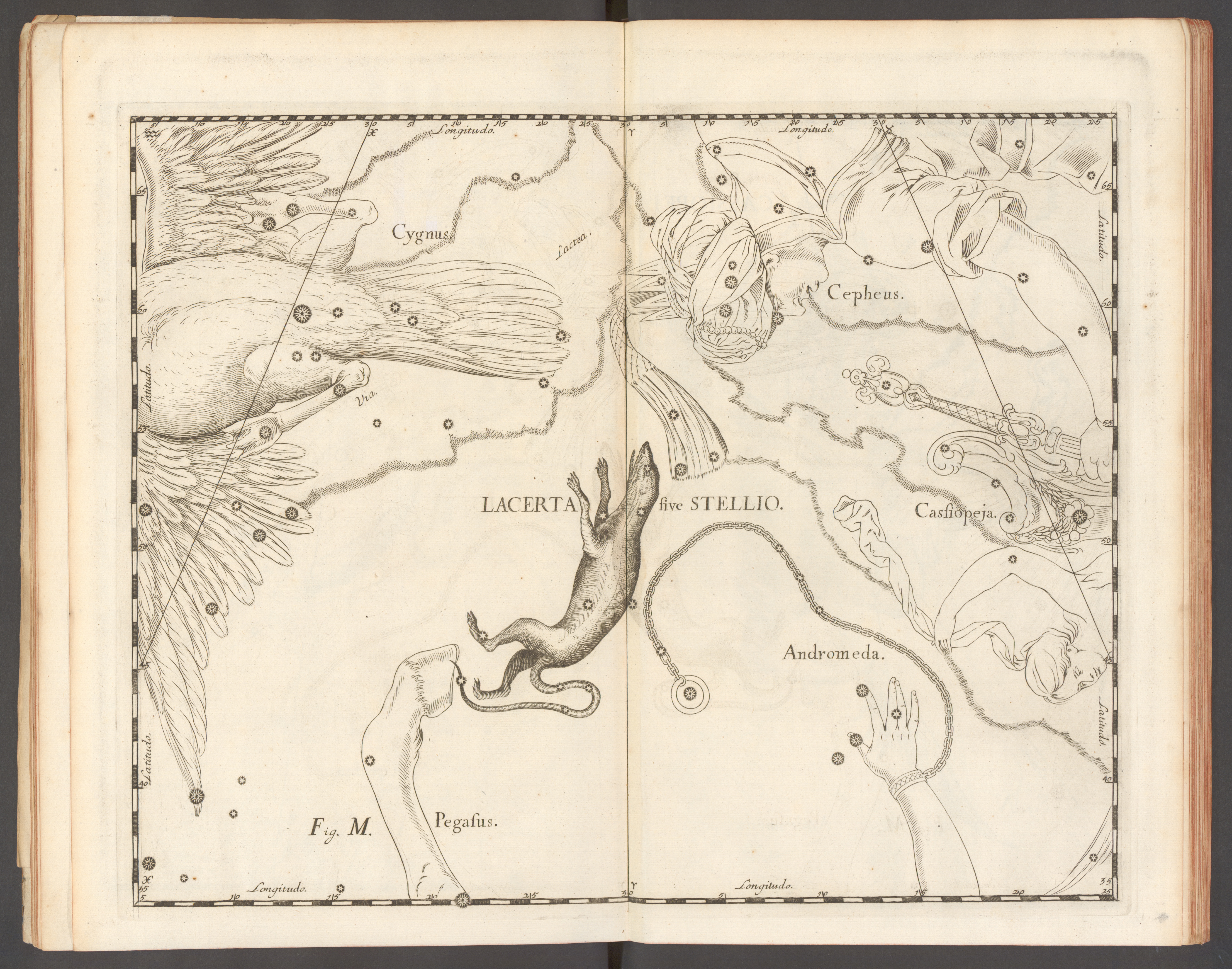
Lacertae ſive Stellio (Lacerta or Stellio) snuggles among the versicolor lizard's quintet of well-known neighbors, comprising Andromeda the Chained Maiden, Cassiopeia the Seated Queen, Cepheus the King, Cygnus the Swan and Pegasus the Winged Horse; Hevelius's depiction from perspective of outsider looking into celestial globe reverses actual east-west appearance of sky for Earth-based observer as insider looking outward at celestial globe; J. Hevelii, Firmamentum Sobiescianum (MDCXC [1690]), Fig. M: Public Domain, via ETH-Bibliothek e-rara

Seventeenth-century Polish astronomer Johannes Hevelius introduced Lacerta the Lizard constellation in 1687 as a versicolor little animal fitting well in a narrow space of unformed stars between Andromeda the Chained Maiden and Cygnus the Swan.
Johannes Hevelius (Polish: Jan Heweliusz; Jan. 28, 1611-Jan. 28, 1687) offered Cygnus the Swan constellation as one of his 10 newly created constellations in Prodromus Astronomiae. The three-volume compendium contained the Prodromus; a star catalogue, Catalogus Stellarum Fixarum; and a star atlas, Firmamentum Sobiescianum sive Uranographia. Hevelius's death left the Prodromus Astronomiae uncompleted and the catalogue and star atlas, which had been printed in 1687, unpublished. The astronomer-selenographer's wife, Polish astronomer Elisabeth Catherina Koopmann Hevelius (Polish: Elżbieta Koopman Heweliusz; Jan. 17, 1647–Dec. 22, 1693), finalized the Prodromus and then published all three volumes in 1690 under the posthumous authorship of her husband.
Lacerta appeared as the second of Hevelius's 10 newly created constellations in Chapter VIII, De Numero Aſteriſmorum & Stellarum, tum nonnullis Rebus animadverſione dignis, of section Tabulae Solares Novae ("New Solar Tables") in the Prodromus. Although narrow, the space of unformed stars between Andromeda the Chained Maiden and Cygnus the Swan, nevertheless, allowed for a standing large animal. Accordingly, a little animal such as a lizard conformed nicely to the available area. The space's narrowness enhanced the effect of the ten stars forming Lacerta so that the versicolor lizard appeared to be adorned with stars.
"De loco Lacertae ſive Stellionis. Secundò, Lacertam ſive Stellionem, quam inter Andromedam, & Cygnum repoſui, eam ob cauſam elegi, quòd ibidem in tali anguſto loco magnum aliquod animal conſiſtere minimè poſſet, etiamſi decem lucidisſimis Stellulis, spatium iſtud eſſet refertum: adhaec, ut autores volunt, ſit animalculum verſicolor, quaſi plurimis Stellulis exornatum; id quod Noſtro animalculo Coeleſti omnium optimè convenit," explained Hevelius.
Hevelius alternatively named his constellatory lizard Stellio, after the starred agama, as noted by English astronomy writer Ian Ridpath (born May 1, 1947) in "Lacerta the Lizard" in Chapter Three: The Celestial Eighty-Eight of Star Tales on his eponymous website (www.ianridpath.com). The color-changing starred agama (Stellagama stellio Baig et al., 2012; Laudakia stellio Linnaeus, 1758) is native to northwestern Africa, southwestern Asia and Greece, according to British science writer, technical editor and palaeozoologist Darren Naish's Tetrapod Zoology post "Stellagama the Rainbow Dragon," published May 25, 2017, on Scientific American's blogging collective.

Seventeenth-century Polish astronomer Johannes Hevelius named his new saurian constellation Lacerta the Lizard, with the alternative name of Stellio, after northwestern Africa and southwestern Asia's starred agama (Stellagama stellio Baig et al., 2012; Laudakia stellio Linnaeus, 1758); starred agama subspecies roughtail rock agama (Stellagama stellio brachydactyla) is the starred agama species most commonly seen in captivity, according to British science writer, technical editor and palaeozoologist Darren Naish; Friday, May 11, 2018, 13:21, image of roughtail rock agama, Dana Biosphere Reserve (Arabic: محمية ضانا للمحيط الحيوي), south central Jordan: Charles J. Sharp (Charlesjsharp), CC BY SA 4.0 International, via Wikimedia Commons

Lacerta the Lizard neighbors with five constellations. Northern neighbors Cassiopeia the Seated Queen and Cepheus the King define Lacerta's northeastern and northern borders, respectively. Andromeda the Seated Queen touches most of eastern Lacerta and a small section of the Lizard's southeastern border. Cygnus the Swan stretches along Lacerta's western border. Pegasus the Winged Horse's front hooves approach Lacerta's hind feet on the Lizard's southern border.
With an area of 200.7 square degrees, Lacerta the Lizard constellation occupies 0.486 percent of the sky, according to the table of constellations on Ian Ridpath's website. Vulpecula's area places it as the 68th largest of the 88 constellations recognized by the International Astronomical Union (IAU).
Right ascension (abbreviated RA; symbol α) coordinates for Lacerta extend from 21 hours 57 minutes 30.3937 seconds to 22h 57m 51.6729s, according to the constellation boundary tables on the International Astronomical Union's website. In the equatorial coordinate system, right ascension relates with terrestrial longitude.
Declination (abbreviated dec; symbol δ) coordinates for Lacerta stretch from plus 35.1656151 to plus 56.9179611. The equatorial coordinate system's declination identifies with geographic latitude.
Constellation Lacerta offers full visibility to Earth-based observers located between latitudes 90 degrees north and 33 degrees south. Partial visibility of the saurian constellation is available to stargazers positioned between latitudes 33 degrees south and 54 degrees south in the southern hemisphere (Ridpath, Constellations -- 2).
Lacerta maintains a year-round above-horizon presence via full or partial visibility, according to science writer Kelly Kizer Whitt in "Lacerta the Lizard, home to a blazar," published Oct. 3, 2021, on the EarthSky website. Hevelius's saurian constellation numbers among 17 summer constellations listed by the American Association of Amateur Astronomers (AAAA) on The Constellation Home Page on the organization's website. Lacerta's summer presence continues into the autumn, with October qualifying as the constellation's best viewing month, according to James Miller in "Star Constellation Facts: Lacerta," posted April 11, 2017, on his website, Astronomy Trek.

Cygnus with the Swan's eastern neighbor, Lacerta the Lizard (right center-lower); Hevelius's depiction from perspective of outsider looking into celestial globe reverses actual east-west appearance of sky for Earth-based observer as insider looking outward at celestial globe; J. Hevelii, Firmamentum Sobiescianum (MDCXC [1690]), Fig. K: Public Domain, via ETH-Bibliothek e-rara

Acknowledgment
My special thanks to talented artists and photographers/concerned organizations who make their fine images available on the internet.

Dedication
This post is dedicated to the memory of our beloved blue-eyed brother, Charles, who guided the creation of the Met Opera and Astronomy posts on Earth and Space News. We memorialized our brother in "Our Beloved Blue-Eyed Brother, Charles, With Whom We Are Well Pleased," published on Earth and Space News on Thursday, Nov. 18, 2021, an anniversary of our beloved father's death.

Image credits:
Lacertae ſive Stellio (Lacerta or Stellio) snuggles among the versicolor lizard's quintet of well-known neighbors, comprising Andromeda the Chained Maiden, Cassiopeia the Seated Queen, Cepheus the King, Cygnus the Swan and Pegasus the Winged Horse; Hevelius's depiction from perspective of outsider looking into celestial globe reverses actual east-west appearance of sky for Earth-based observer as insider looking outward at celestial globe; J. Hevelii, Firmamentum Sobiescianum (MDCXC [1690]), Fig. M: Public Domain, via ETH-Bibliothek e-rara @ https://www.e-rara.ch/zut/content/zoom/133903
Seventeenth-century Polish astronomer Johannes Hevelius named his new saurian constellation Lacerta the Lizard, with the alternative name of Stellio, after northwestern Africa and southwestern Asia's starred agama (Stellagama stellio Baig et al., 2012; Laudakia stellio Linnaeus, 1758); starred agama subspecies roughtail rock agama (Stellagama stellio brachydactyla) is the starred agama species most commonly seen in captivity, according to British science writer, technical editor and palaeozoologist Darren Naish; Friday, May 11, 2018, 13:21, image of roughtail rock agama, Dana Biosphere Reserve (Arabic: محمية ضانا للمحيط الحيوي), south central Jordan: Charles J. Sharp (Charlesjsharp), CC BY SA 4.0 International, via Wikimedia Commons @ https://commons.wikimedia.org/wiki/File:Roughtail_rock_agama_(Stellagama_stellio_brachydactyla).jpg
Cygnus with the Swan's eastern neighbor, Lacerta the Lizard (right center-lower); Hevelius's depiction from perspective of outsider looking into celestial globe reverses actual east-west appearance of sky for Earth-based observer as insider looking outward at celestial globe; J. Hevelii, Firmamentum Sobiescianum (MDCXC [1690]), Fig. K: Public Domain, via ETH-Bibliothek e-rara @ https://www.e-rara.ch/zut/content/zoom/133899

For further information:
The American Association of Amateur Astronomers. "The Summer Constellations." The American Association of Amateur Astronomers > The Constellation Home Page.
Available @ http://www.astromax.org/con-page/con-sumr.htm
Hevelii, Johannis. "De loco Lacertae ſive Stellionis. Secundò, Lacertam ſive Stellionem, quam inter Andromedam, & Cygnum repoſui, eam ob cauſam elegi, quòd ibidem in tali anguſto loco magnum aliquod animal conſiſtere minimè poſſet, etiamſi decem lucidisſimis Stellulis, spatium iſtud eſſet refertum: adhaec, ut autores volunt, ſit animalculum verſicolor, quaſi plurimis Stellulis exornatum; id quod Noſtro animalculo Coeleſti omnium optimè convenit." Page 114. Prodromus Astronomiae cum Catalogo Fixarum, & Firmamentum Sobiescianum: Prodromus Astronomiae . . . Quibus additus est uterq[ue] Catalogus Stellarum Fixarum, tam major ad Annum 1660, quàm minor ad Annum completum 1700. Acceſſ Corollarii loco Tabula Motus Lunae Libratorii, Ad bina ſecula proximè ventura prolongata, brevi cum Deſcriptione, ejus ue uſu. Tabulae Solares Novae, pages 51-142. Caput VIII De Numero Aſteriſmorum & Stellarum, tum nonnullis Rebus animadverſione dignis," pages 108-124. Gedani [Gdansk]: Typis Johannis-Zachariae Stollii, M DC XC [1690].
Available via ETH-Bibliothek e-rara @ https://www.e-rara.ch/zut/content/zoom/133606
Available via National Digital Library Polona @ https://polona.pl/item-view/049ab5c8-5726-4a52-ad1b-48f3f475c4f2?page=73
Available via Google Books Read Free of Charge @ https://www.google.com/books/edition/JOHANNIS_HEVELII_PRODROMUS_ASTRONOMIAE/OEPatgAACAAJ?hl=en&gbpv=1&printsec=frontcover
Available via Linda Hall Library of Science, Engineering & Technology Catalog @ https://catalog.lindahall.org/discovery/delivery/01LINDAHALL_INST:LHL/1284873740005961
Hevelii, Johannis. "Lacerta ſive Stellio." Page 290. Catalogus Stellarum Fixarum ad Annum Christi M DCC Completum. Pages 269-308. In: Prodromus Astronomiae . . . Quibus additus est uterq[ue] Catalogus Stellarum Fixarum, tam major ad Annum 1660, quàm minor ad Annum completum 1700. Acceſſ Corollarii loco Tabula Motus Lunae Libratorii, Ad bina ſecula proximè ventura prolongata, brevi cum Deſcriptione, ejus ue uſu. Gedani [Gdansk]: Typis Johannis-Zachariae Stollii, M DC XC [1690].
Available via ETH-Bibliothek e-rara @ https://www.e-rara.ch/zut/content/zoom/133786
Available via Google Books Read Free of Charge @ https://www.google.com/books/edition/JOHANNIS_HEVELII_PRODROMUS_ASTRONOMIAE/OEPatgAACAAJ?hl=en&gbpv=1&printsec=frontcover
Available via Linda Hall Library of Science, Engineering & Technology Catalog @ https://catalog.lindahall.org/discovery/delivery/01LINDAHALL_INST:LHL/1284873740005961
Hevelii, Johannis. "Lacerta ſive Stellio." Pages 369-370. Machinae Coelestis. Liber Quartus, Rerum Uranicarum Observationes, Gedani. Gedani [Gdansk]: Simon Reiniger, M DC LXXIX [1679].
Available via Internet Archive @ https://archive.org/details/Machinacoelesti2Heve/page/369/mode/1up
Marriner, Derdriu. "Hevelius Crater Parents Seven Satellites at West Oceanus Procellarum." Earth and Space News. Wednesday, Jan. 18, 2023.
Available @ https://earth-and-space-news.blogspot.com/2023/01/hevelius-crater-parents-seven.html
Marriner, Derdriu. "Hevelius Introduced Canes Venatici Constellation in 1687." Earth and Space News. Thursday, May 17, 2023.
Available @ https://earth-and-space-news.blogspot.com/2023/05/hevelius-introduced-canes-venatici.html
Marriner, Derdriu. "Hevelius Introduced Leo Minor the Lesser Leo Constellation in 1687." Earth and Space News. Wednesday, April 5, 2023.
Available @ https://earth-and-space-news.blogspot.com/2023/04/hevelius-introduced-leo-minor-lesser.html
Marriner, Derdriu. "Hevelius Introduced Lynx Constellation in 1687 as Visible to Lynx-Eyed." Earth and Space News. Wednesday, Jan. 25, 2023.
Available @ https://earth-and-space-news.blogspot.com/2023/01/hevelius-introduced-lynx-constellation.html
Marriner, Derdriu. "Hevelius Introduced Mons Maenalus constellation in 1687." Earth and Space News. Wednesday, May 24, 2023.
Available @ https://earth-and-space-news.blogspot.com/2023/05/hevelius-introduced-mons-maenalus.html
Marriner, Derdriu. "Hevelius Introduced Sextans the Sextant Constellation in 1687." Earth and Space News. Wednesday, May 10, 2023.
Available @ https://earth-and-space-news.blogspot.com/2023/05/hevelius-introduced-sextans-sextant.html
Marriner, Derdriu. "Hevelius Introduced Three-Headed Snake Constellation Cerberus in 1687." Earth and Space News. Wednesday, June 29, 2023.
Available @ https://earth-and-space-news.blogspot.com/2023/06/hevelius-introduced-three-headed-snake.html
Marriner, Derdriu. "Hevelius Introduced Vulpecula the Fox Constellation in 1687." Earth and Space News. Wednesday, July 5, 2023.
Available @ https://earth-and-space-news.blogspot.com/2023/07/hevelius-introduced-vulpecula-fox.html
Marriner, Derdriu. "Lynx Zigzags Lengthily Between Ursa Major and Auriga the Charioteer." Earth and Space News. Wednesday, March 1, 2023.
Available @ https://earth-and-space-news.blogspot.com/2023/03/lynx-zigzags-lengthily-between-ursa.html
Marriner, Derdriu. "Near Side Hevelius Crater Honors Polish Astronomer Johannes Hevelius." Earth and Space News. Wednesday, Jan. 11, 2023.
Available @ https://earth-and-space-news.blogspot.com/2023/01/near-side-hevelius-crater-honors-polish.html
Marriner, Derdriu. "Serpens the Serpent Constellation Is the Only Two Part Constellation." Earth and Space News. Wednesday, April 26, 2017.
Available @ https://earth-and-space-news.blogspot.com/2017/04/serpens-serpent-constellation-is-only.html
Marriner, Derdriu. "Summer Triangle of Altair With Deneb and Vega Dramatizes Summer Nights." Earth and Space News. Wednesday, Aug. 10, 2016.
Available @ https://earth-and-space-news.blogspot.com/2016/08/summer-triangle-of-altair-with-deneb.html
Marriner, Derdriu. "Venusian Crater Corpman Honors Astronomer Elisabeth Koopman Hevelius." Earth and Space News. Wednesday, Jan. 4, 2023.
Available @ https://earth-and-space-news.blogspot.com/2023/01/venusian-crater-corpman-honors.html
Miller, James. "Star Constellation Facts: Lacerta." Astronomy Trek. April 11, 2017.
Available @ https://www.astronomytrek.com/star-constellation-facts-lacerta/
Naish, Darren. "Stellagama the Rainbow Dragon: Your regularly scheduled reminder that agamid lizards are out there and that they’re really interesting." Scientific American > Tetrapod Zoology. May 25, 2017.
Available @ https://blogs.scientificamerican.com/tetrapod-zoology/stellagama-the-rainbow-dragon/
Ridpath, Ian. "Constellations 2: Lacerta." Ian Ridpath > The Constellations.
Available @ http://www.ianridpath.com/constellations2.html
Ridpath, Ian. "Hevelius presents his new constellations." Ian Ridpath > Star Tales > Chapter Two > Page 2 > Hevelius and the Firmamentum Sobiescianum.
Available @ http://www.ianridpath.com/startales/hevelius.html
Ridpath, Ian. "Lacerta the Lizard." Star Tales > Chapter Three: The Celestial Eight-Eight.
Available @ http://www.ianridpath.com/startales/lacerta.html
Whitt, Kelly Kizer. "Lacerta the Lizard, home to a blazar." EarthSky > Tonight > Constellations. Oct. 3, 2021.
Available @ https://earthsky.org/constellations/lacerta-the-lizard-blazar/


Wednesday, July 5, 2023

Hevelius Introduced Vulpecula the Fox Constellation in 1687


Summary: Johannes Hevelius introduced Vulpecula the Fox constellation in 1687 as a portrait of a fox with a goose, located within the Summer Triangle asterism.


Anser and Vulpecula with Sagitta the Arrow (center) and with Hercules (upper left) and Cerberus (left center); Hevelius's depiction from perspective of outsider looking into celestial globe reverses actual east-west appearance of sky for Earth-based observer as insider looking outward at celestial globe; J. Hevelii, Firmamentum Sobiescianum (MDCXC [1690]), Fig. L: Public Domain, via ETH-Bibliothek e-rara

Seventeenth-century Polish astronomer Johannes Hevelius introduced Vulpecula the Fox constellation in 1687 as a starry fox with its captured goose located within the Summer Triangle asterism.
Johannes Hevelius (Polish: Jan Heweliusz; Jan. 28, 1611-Jan. 28, 1687) offered Vulpecula the Fox constellation as one of 10 constellations that he had visualized in Prodromus Astronomiae. The three-volume compendium comprised the Prodromus; a star catalogue, Catalogus Stellarum Fixarum; and a star atlas, Firmamentum Sobiescianum sive Uranographia. Hevelius's death left the Prodromus Astronomiae unfinished and the catalogue and star atlas, which had been printed in 1687, unpublished. The astronomer-selenographer's wife, Polish astronomer Elisabeth Catherina Koopmann Hevelius (Polish: Elżbieta Koopman Heweliusz; Jan. 17, 1647–Dec. 22, 1693), completed the Prodromus and then published all three volumes in 1690 under the posthumous authorship of her husband.
Vulpecula appeared as the eighth of Hevelius's 10 newly created constellations in Chapter VIII, De Numero Aſteriſmorum & Stellarum, tum nonnullis Rebus animadverſione dignis, of section Tabulae Solares Novae ("New Solar Tables") in the Prodromus. He envisioned Vulpecula as a successful predator and thief, with the neck of captive Anser the Goose in his mouth. Hevelius found congruency in the natures of Vulpecula and neighbors Aquila the Eagle and Lyra the Lyre, in an alternative representation as an Eagle with a Lyre. The trio psychologized as cunning, voracious, thieving predators (quidem tale animalculum quod admodùm Aſtutum, vorax, & furax eſt; page 117). Hevelius related Vulpecula to a third constellation, Cerberus the Three-Headed Snake, as the recipient of Vulpecula's goose.
"Cur Vulpecula cum Anſere eo in loco fuerit rejecta. Ex Stellis autem iſtis, quae inter Aquilam & Lyram, ſub Cygno, haud procul à Cerbero, horribili illo & voraci animali, vel à Cane infernali Tricipiti (prout Poetae fabulantur) videntur, numero 27, nimirùm cum unâ olim jam cognitâ, & 26 novis meis à me ſolummodò obſervatis, ſimul cum illâ planè novâ, quae Anno primùm 1672 apparuit, ac per biennium in Coelo fulſit, volui Vulpeculam cum Anſere, in ſpatio Coeli benè apto, & quidem tale animalculum quod admodùm Aſtutum, vorax, & furax eſt, reponere. Attento, quòd Aquila & Lyra ejusdem ſint naturae; nimirùm rapaces & edaces: ne non & hae Stellae in Vulpeculâ, cum illis in Aquilâ & Lyrâ conſtitutis, eandem conſeervent naturam," Hevelius explained (page 117).

Hevelius's sky chart for Aquila the Eagle (center) and Antinous the Beloved of Hadrian (center right) shows Anser the Goose-mouthed Vulpecula planning to cross the Milky Way (Via Lactea) with anserine gift for Cerberus the Three-Headed Snake; Hevelius's depiction from perspective of outsider looking into celestial globe reverses actual east-west appearance of sky for Earth-based observer as insider looking outward at celestial globe; J. Hevelii, Firmamentum Sobiescianum (MDCXC [1690]), Fig. R: Public Domain, via ETH-Bibliothek e-rara

Vulpecula the Fox neighbors with six constellations. Cygnus the Swan, Lacerta the Lizard and Lyra the Lyre define Vulpecula's northern borders. Hercules the Hero postures to the north and west. Delphinus the Dolphin and Sagitta the Arrow mark the Fox's southern borders. Pegasus the Winged Horse flies along Vulpecula's eastern and southeastern extents.
Hevelius's Fox numbers as one of two small constellations lying in the Summer Triangle, an asterism, or recognizable pattern of stars, that prettifies summer nights in the northern hemisphere. The Summer Triangle comprises the brightest stars of constellation Cygnus, of Lyra the Lyre, the Swan's western neighbor, and of Aquila the Eagle, the southern neighbor of Sagitta the Arrow, the Swan's southern neighbor. Vulpecula and Sagitta mainly shelter within the triangulation of Altair (Alpha Aquilae, α Aquilae; abbreviated Alpha Aql, α Aql) in Aquila the Eagle, Deneb (Alpha Cygni, α Cygni; abbreviated to Alpha Cyg, α Cyg) in Cygnus the Swan and Vega (Alpha Lyrae, α Lyrae; abbreviated Alpha Lyr, α Lyr) in Lyra the Lyre.

Cygnus (center) over the Swan's alert southern neighbor, Vulpecula, with the Fox's prey, Anser the Goose; Hevelius's depiction from perspective of outsider looking into celestial globe reverses actual east-west appearance of sky for Earth-based observer as insider looking outward at celestial globe; J. Hevelii, Firmamentum Sobiescianum (MDCXC [1690]), Fig. K: Public Domain, via ETH-Bibliothek e-rara

With an area of 268.2 square degrees, Vulpecula the Fox constellation occupies 0.650 percent of the sky, according to English astronomy writer Ian Ridpath (born May 1, 1947) in his table of constellations on his eponymous website (ianridpath.com). Vulpecula's area places it as the 55th largest of the 88 constellations recognized by the International Astronomical Union (IAU).
Right ascension (abbreviated RA; symbol α) coordinates for Vulpecula extend from 18 hours 57 minutes 06.5189 seconds to 21h 30m 38.8847s, according to the constellation boundary tables on the International Astronomical Union's website. In the equatorial coordinate system, right ascension relates with terrestrial longitude.
Declination (abbreviated dec; symbol δ) coordinates for Vulpecula stretch from plus 19.3982983 to plus 29.4871387. The equatorial coordinate system's declination identifies with geographic latitude.
Constellation Vulpecula offers full visibility to Earth-based observers located between latitudes 90 degrees north and 61 degrees south. Partial visibility of the vulpine constellation is available to stargazers positioned between latitudes 61 degrees south and 62 degrees south in the southern hemisphere (Ridpath, Constellations -- 2).
Hevelius's vulpine constellation numbers among 17 summer constellations listed by the American Association of Amateur Astronomers (AAAA) on The Constellation Home Page on the organization's website. Vulpecula also participates in the starry-rich area of the autumnal sky that the Fox shares with Cygnus the Swan, Lyra the Lyre and Sagitta the Arrow, according to AAAA's profile of "The Constellation Vulpecula -- The Little Fox."
September qualifies for best viewing of Vulpecula the Fox constellation in the northern hemisphere, according to James Miller in "Star Constellation Facts: Vulpecula," posted Dec. 1, 2016, on his website, Astronomy Trek. Vulpecula's September noticeability advantages the Summer Triangle's early autumn prominence in northern skies.

Delphinus the Dolphin (center) and Equuleus the Little Horse (bottom center right), with the Dolphin's northern neighbor, Vulpecula the Fox; Hevelius's depiction from perspective of outsider looking into celestial globe reverses actual east-west appearance of sky for Earth-based observer as insider looking outward at celestial globe; J. Hevelii, Firmamentum Sobiescianum (MDCXC [1690]), Fig. S: Public Domain, via ETH-Bibliothek e-rara

Acknowledgment
My special thanks to talented artists and photographers/concerned organizations who make their fine images available on the internet.

Dedication
This post is dedicated to the memory of our beloved blue-eyed brother, Charles, who guided the creation of the Met Opera and Astronomy posts on Earth and Space News. We memorialized our brother in "Our Beloved Blue-Eyed Brother, Charles, With Whom We Are Well Pleased," published on Earth and Space News on Thursday, Nov. 18, 2021, an anniversary of our beloved father's death.

Image credits:
Anser and Vulpecula with Sagitta the Arrow (center) and with Hercules (upper left) and Cerberus (left center); Hevelius's depiction from perspective of outsider looking into celestial globe reverses actual east-west appearance of sky for Earth-based observer as insider looking outward at celestial globe; J. Hevelii, Firmamentum Sobiescianum (MDCXC [1690]), Fig. L: Public Domain, via ETH-Bibliothek e-rara @ https://www.e-rara.ch/zut/content/zoom/133901
Hevelius's sky chart for Aquila the Eagle (center) and Antinous the Beloved of Hadrian (center right) shows Anser the Goose-mouthed Vulpecula planning to cross the Milky Way (Via Lactea) with anserine gift for Cerberus the Three-Headed Snake; Hevelius's depiction from perspective of outsider looking into celestial globe reverses actual east-west appearance of sky for Earth-based observer as insider looking outward at celestial globe; J. Hevelii, Firmamentum Sobiescianum (MDCXC [1690]), Fig. R: Public Domain, via ETH-Bibliothek e-rara @ https://www.e-rara.ch/zut/content/zoom/133913
Cygnus (center) over the Swan's alert southern neighbor, Vulpecula, with the Fox's prey, Anser the Goose; Hevelius's depiction from perspective of outsider looking into celestial globe reverses actual east-west appearance of sky for Earth-based observer as insider looking outward at celestial globe; J. Hevelii, Firmamentum Sobiescianum (MDCXC [1690]), Fig. K: Public Domain, via ETH-Bibliothek e-rara @ https://www.e-rara.ch/zut/content/zoom/133899
Delphinus the Dolphin (center) and Equuleus the Little Horse (bottom center right), with the Dolphin's northern neighbor, Vulpecula the Fox; Hevelius's depiction from perspective of outsider looking into celestial globe reverses actual east-west appearance of sky for Earth-based observer as insider looking outward at celestial globe; J. Hevelii, Firmamentum Sobiescianum (MDCXC [1690]), Fig. S: Public Domain, via ETH-Bibliothek e-rara @ https://www.e-rara.ch/zut/content/zoom/133915

For further information:
The American Association of Amateur Astronomers. "The Summer Constellations." The American Association of Amateur Astronomers > The Constellation Home Page.
Available @ http://www.astromax.org/con-page/con-sumr.htm
Hevelii, Johannis. "Cur Vulpecula cum Anſere eo in loco fuerit rejecta. Ex Stellis autem iſtis, quae inter Aquilam & Lyram, ſub Cygno, haud procul à Cerbero, horribili illo & voraci animali, vel à Cane infernali Tricipiti (prout Poetae fabulantur) videntur, numero 27, nimirùm cum unâ olim jam cognitâ, & 26 novis meis à me ſolummodò obſervatis, ſimul cum illâ planè novâ, quae Anno primùm 1672 apparuit, ac per biennium in Coelo fulſit, volui Vulpeculam cum Anſere, in ſpatio Coeli benè apto, & quidem tale animalculum quod admodùm Aſtutum, vorax, & furax eſt, reponere. Attento, quòd Aquila & Lyra ejusdem ſint naturae; nimirùm rapaces & edaces: ne non & hae Stellae in Vulpeculâ, cum illis in Aquilâ & Lyrâ conſtitutis, eandem conſeervent naturam." Page 117. Prodromus Astronomiae cum Catalogo Fixarum, & Firmamentum Sobiescianum: Prodromus Astronomiae . . . Quibus additus est uterq[ue] Catalogus Stellarum Fixarum, tam major ad Annum 1660, quàm minor ad Annum completum 1700. Acceſſ Corollarii loco Tabula Motus Lunae Libratorii, Ad bina ſecula proximè ventura prolongata, brevi cum Deſcriptione, ejus ue uſu. Tabulae Solares Novae, pages 51-142. Caput VIII De Numero Aſteriſmorum & Stellarum, tum nonnullis Rebus animadverſione dignis," pages 108-124. Gedani [Gdansk]: Typis Johannis-Zachariae Stollii, M DC XC [1690].
Available via ETH-Bibliothek e-rara @ https://www.e-rara.ch/zut/content/zoom/133609
Available via National Digital Library Polona @ https://polona.pl/item-view/049ab5c8-5726-4a52-ad1b-48f3f475c4f2?page=73
Available via Google Books Read Free of Charge @ https://www.google.com/books/edition/JOHANNIS_HEVELII_PRODROMUS_ASTRONOMIAE/OEPatgAACAAJ?hl=en&gbpv=1&printsec=frontcover
Available via Linda Hall Library of Science, Engineering & Technology Catalog @ https://catalog.lindahall.org/discovery/delivery/01LINDAHALL_INST:LHL/1284873740005961
Hevelii, Johannis. "De Cerbero. Dicta haec Vulpecula, furto ſurripuit Anſerem, quam in ore gerens veloci curſu ad Cerberum, Tricipitem nempe illum Canem infernalem voracem deportat, quò Jentaculum & ſolatium quaſi habeat, antequam ab Hercule clavamjam exporrigente, occidatur. Sic ut haec Vulpecula cum Anſere, etiam juxta fabulas Poetarum, & Aſtrologorum Regulas, convenienter hoc loco reponi à me potuerit. Haud minùs benè factum, quòd Herculi, Cerberum ſiniſtrâ manu tenendum tradiderim." Page 117. Prodromus Astronomiae cum Catalogo Fixarum, & Firmamentum Sobiescianum: Prodromus Astronomiae . . . Quibus additus est uterq[ue] Catalogus Stellarum Fixarum, tam major ad Annum 1660, quàm minor ad Annum completum 1700. Acceſſ Corollarii loco Tabula Motus Lunae Libratorii, Ad bina ſecula proximè ventura prolongata, brevi cum Deſcriptione, ejus ue uſu. Tabulae Solares Novae, pages 51-142. Caput VIII De Numero Aſteriſmorum & Stellarum, tum nonnullis Rebus animadverſione dignis," pages 108-124. Gedani [Gdansk]: Typis Johannis-Zachariae Stollii, M DC XC [1690].
Available via ETH-Bibliothek e-rara @ https://www.e-rara.ch/zut/content/zoom/133609
Available via National Digital Library Polona @ https://polona.pl/item-view/049ab5c8-5726-4a52-ad1b-48f3f475c4f2?page=73
Available via Google Books Read Free of Charge @ https://www.google.com/books/edition/JOHANNIS_HEVELII_PRODROMUS_ASTRONOMIAE/OEPatgAACAAJ?hl=en&gbpv=1&printsec=frontcover
Available via Linda Hall Library of Science, Engineering & Technology Catalog @ https://catalog.lindahall.org/discovery/delivery/01LINDAHALL_INST:LHL/1284873740005961
Hevelii, Johannis. "Vulpecul cum Ansere." Page 308. Catalogus Stellarum Fixarum ad Annum Christi M DCC Completum. Pages 269-308. In: Prodromus Astronomiae . . . Quibus additus est uterq[ue] Catalogus Stellarum Fixarum, tam major ad Annum 1660, quàm minor ad Annum completum 1700. Acceſſ Corollarii loco Tabula Motus Lunae Libratorii, Ad bina ſecula proximè ventura prolongata, brevi cum Deſcriptione, ejus ue uſu. Gedani [Gdansk]: Typis Johannis-Zachariae Stollii, M DC XC [1690].
Available via ETH-Bibliothek e-rara @ https://www.e-rara.ch/zut/content/zoom/133804
Available via Google Books Read Free of Charge @ https://www.google.com/books/edition/JOHANNIS_HEVELII_PRODROMUS_ASTRONOMIAE/OEPatgAACAAJ?hl=en&gbpv=1&printsec=frontcover
Available via Linda Hall Library of Science, Engineering & Technology Catalog @ https://catalog.lindahall.org/discovery/delivery/01LINDAHALL_INST:LHL/1284873740005961
Hevelii, Johannis. "Vulpecula." Pages 418-419. Machinae Coelestis. Liber Quartus, Rerum Uranicarum Observationes, Gedani. Gedani [Gdansk]: Simon Reiniger, M DC LXXIX [1679].
Available via Internet Archive @ https://archive.org/details/Machinacoelesti2Heve/page/428/mode/1up
Marriner, Derdriu. "Hevelius Crater Parents Seven Satellites at West Oceanus Procellarum." Earth and Space News. Wednesday, Jan. 18, 2023.
Available @ https://earth-and-space-news.blogspot.com/2023/01/hevelius-crater-parents-seven.html
Marriner, Derdriu. "Hevelius Introduced Canes Venatici Constellation in 1687." Earth and Space News. Thursday, May 17, 2023.
Available @ https://earth-and-space-news.blogspot.com/2023/05/hevelius-introduced-canes-venatici.html
Marriner, Derdriu. "Hevelius Introduced Leo Minor the Lesser Leo Constellation in 1687." Earth and Space News. Wednesday, April 5, 2023.
Available @ https://earth-and-space-news.blogspot.com/2023/04/hevelius-introduced-leo-minor-lesser.html
Marriner, Derdriu. "Hevelius Introduced Lynx Constellation in 1687 as Visible to Lynx-Eyed." Earth and Space News. Wednesday, Jan. 25, 2023.
Available @ https://earth-and-space-news.blogspot.com/2023/01/hevelius-introduced-lynx-constellation.html
Marriner, Derdriu. "Hevelius Introduced Mons Maenalus constellation in 1687." Earth and Space News. Wednesday, May 24, 2023.
Available @ https://earth-and-space-news.blogspot.com/2023/05/hevelius-introduced-mons-maenalus.html
Marriner, Derdriu. "Hevelius Introduced Sextans the Sextant Constellation in 1687." Earth and Space News. Wednesday, May 10, 2023.
Available @ https://earth-and-space-news.blogspot.com/2023/05/hevelius-introduced-sextans-sextant.html
Marriner, Derdriu. "Hevelius Introduced Three-Headed Snake Constellation Cerberus in 1687." Earth and Space News. Wednesday, June 29, 2023.
Available @ https://earth-and-space-news.blogspot.com/2023/06/hevelius-introduced-three-headed-snake.html
Marriner, Derdriu. "Lynx Zigzags Lengthily Between Ursa Major and Auriga the Charioteer." Earth and Space News. Wednesday, March 1, 2023.
Available @ https://earth-and-space-news.blogspot.com/2023/03/lynx-zigzags-lengthily-between-ursa.html
Marriner, Derdriu. "Near Side Hevelius Crater Honors Polish Astronomer Johannes Hevelius." Earth and Space News. Wednesday, Jan. 11, 2023.
Available @ https://earth-and-space-news.blogspot.com/2023/01/near-side-hevelius-crater-honors-polish.html
Marriner, Derdriu. "Serpens the Serpent Constellation Is the Only Two Part Constellation." Earth and Space News. Wednesday, April 26, 2017.
Available @ https://earth-and-space-news.blogspot.com/2017/04/serpens-serpent-constellation-is-only.html
Marriner, Derdriu. "Summer Triangle of Altair With Deneb and Vega Dramatizes Summer Nights." Earth and Space News. Wednesday, Aug. 10, 2016.
Available @ https://earth-and-space-news.blogspot.com/2016/08/summer-triangle-of-altair-with-deneb.html
Marriner, Derdriu. "Venusian Crater Corpman Honors Astronomer Elisabeth Koopman Hevelius." Earth and Space News. Wednesday, Jan. 4, 2023.
Available @ https://earth-and-space-news.blogspot.com/2023/01/venusian-crater-corpman-honors.html
Miller, James. "Star Constellation Facts: Vulpecula." Astronomy Trek. Dec. 1, 2016.
Available @ https://www.astronomytrek.com/star-constellation-facts-canes-venatici/
Ridpath, Ian. "Constellations 2: Vulpecula." Ian Ridpath > The Constellations.
Available @ http://www.ianridpath.com/constellations2.html
Ridpath, Ian. "Hevelius presents his new constellations." Ian Ridpath > Star Tales > Chapter Two > Page 2 > Hevelius and the Firmamentum Sobiescianum.
Available @ http://www.ianridpath.com/startales/hevelius.html
Ridpath, Ian. "Lyra The Lyre." Star Tales > Chapter Three: The Celestial Eight-Eight.
Available @ http://www.ianridpath.com/startales/lyra.html
Ridpath, Ian. "Vulpecula The Fox." Star Tales > Chapter Three: The Celestial Eighty-Eight.
Available @ http://www.ianridpath.com/startales/vulpecula.html
Whitt, Kelly Kizer."Vulpecula the Fox lies inside the Summer Triangle." EarthSky > Tonight > Constellations. July 1, 2022.
Available @ https://earthsky.org/constellations/vulpecula-the-fox-summer-triangle-coathanger-dumbbell-nebula/