More than 2.7-million-plus views, thanks to EASN's many readers!

Wednesday, March 9, 2011

Near Side Crater J. Herschel Parents Five Satellites Within Its Borders


Summary: Near side crater J. Herschel parents five satellites within its borders as a north polar region crater system on northwestern Mare Frigoris (Sea of Cold).


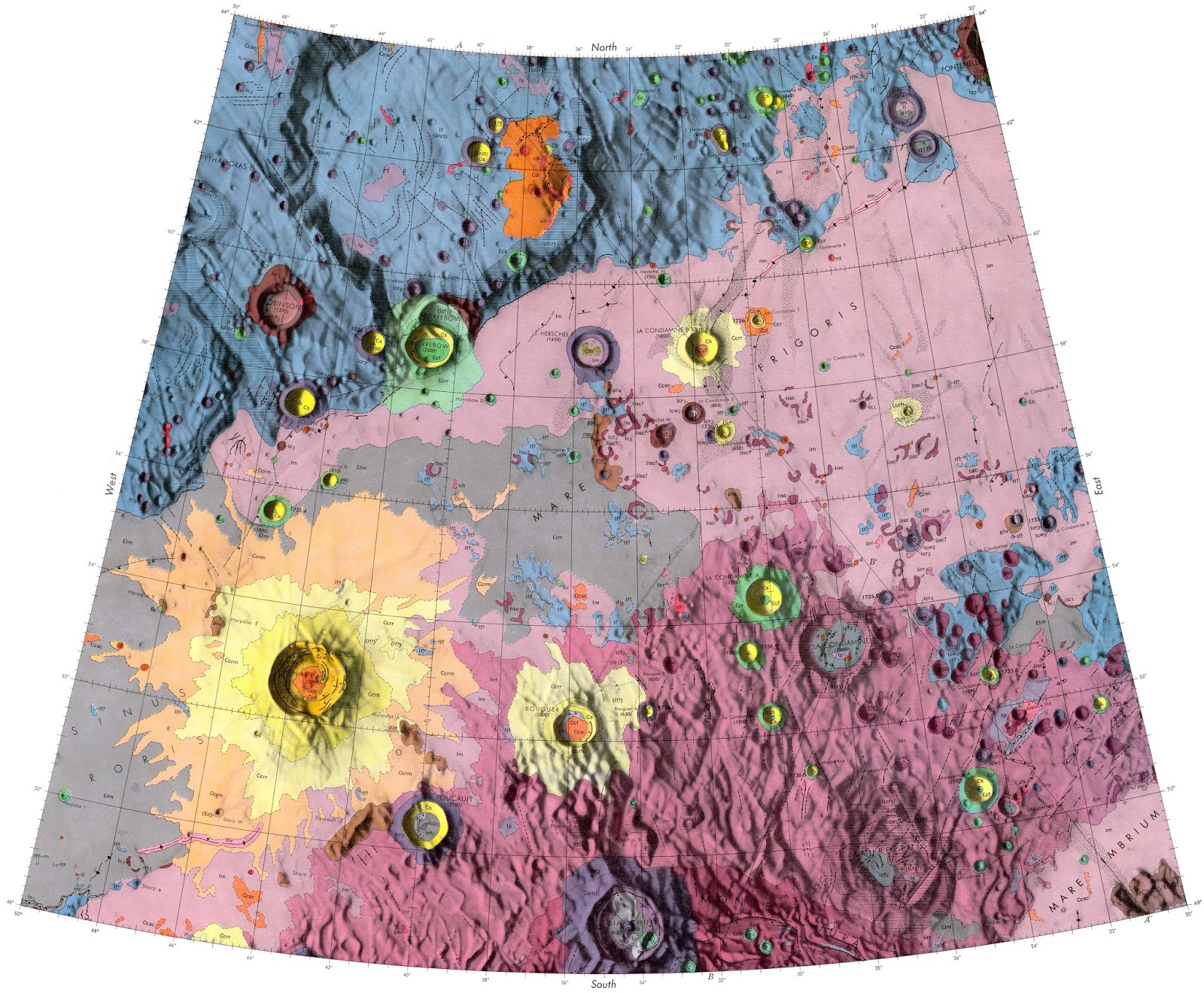
Detail shows lunar near side J. Herschel Crater system of parent and 10 satellites on northwestern Mare Frigoris; LAC (Lunar Aeronautical Chart) 11: NASA / GSFC (Goddard Space Flight Center) / ASU (Arizona State University, Public Domain, via U.S. Geological Survey / Gazetter of Planetary Nomenclature

Near side crater J. Herschel parents five satellites within its borders as a north polar region crater system on the northwest quadrant’s crater-rich northwestern edge of Mare Frigoris (Sea of Cold).
J. Herschel Crater’s southeastern rim anchors the northwestern Mare Frigoris. The elongated lunar mare (Latin: sea) primarily occupies the lunar near side’s northeast quadrant but stretches into the northwest quadrant. Mare Frigoris is centered at 57.59 degrees north latitude and minus 0.01 degrees west longitude, according to the International Astronomical Union’s (IAU) Gazetteer of Planetary Nomenclature. It encompasses mid- and polar latitudes, with northernmost and southernmost latitudes of 64.38 degrees north and 49.08 degrees north, respectively. The basaltic lava plain’s easternmost and westernmost longitudes stretch from 38.03 degrees east to minus 43.14 degrees west, respectively. Mare Frigoris has a diameter of 1,446.41 kilometers.
English amateur astronomer William Radcliffe Birt (July 15, 1804-Dec. 14, 1881) Birt cited the esteem in which German astronomer and selenographer Johann Heinrich von Mädler (May 29, 1794-March 14, 1874) and his wealthy patron, Prussian banker, astronomer and selenographer Wilhelm Wolff Beer (Jan. 4, 1797-March 27, 1850) held the north polar region bordering Mare Frigoris. They considered “. . . the region between Horrebow, Anaximander, and Fontenelle as an exceedingly rich crater country; the principal part consisting of the region of Herschel II” (page 11), according to Birt’s report for the British Association for the Advancement of Science’s 32nd meeting in October 1862.
J. Herschel Crater lies southeast of Anaximander Crater, which is centered at 66.97 degrees north latitude, minus 51.44 degrees west longitude. Fontenelle Crater is located along northern Mare Frigoris, to the northeast of J. Herschel. Horrebow Crater perches on northwestern Mare Frigoris in an overlay of the southwestern part of its satellite, Horrebow A, which, in turn, is attached to J. Herschel’s southeastern rim.
J. Herschel Crater is centered at 62.31 degrees north latitude, minus 41.86 degrees west longitude. The lunar impact crater registers northernmost and southernmost latitudes at 64.86 degrees north and 59.77 degrees north, respectively. It marks easternmost and westernmost longitudes at minus 36.37 degrees west and minus 47.35 degrees west, respectively. J. Herschel Crater’s diameter measures 154.44 kilometers.
J. Herschel forms a crater system as the parent of 10 satellites. Its satellites all claim easterly placements with respect to their parent.
Five of the system’s 10 satellites are found within their parent’s borders. Four satellites occupy their parent’s interior. Satellites C, D, K and L trace a sideways arch on their parent’s eastern floor. Satellite B is attached to its parent’s southeastern rim.
J. Herschel K claims the most northerly position of its parent’s four internal satellites. K is centered at 62.96 degrees north latitude, minus 39.47 degrees west longitude. It finds northernmost and southernmost latitudes at 63.1 degrees north and 62.82 degrees north, respectively. It posts easternmost and westernmost longitudes of minus 39.17 degrees west and minus 39.78 degrees west, respectively. K has a diameter of 8.38 kilometers.
J. Herschel C lies to the southwest of J. Herschel K. C is centered at 62.39 degrees north latitude, minus 40.15 degrees west longitude. C tethers in its northernmost and southernmost latitudes at 62.61 degrees north and 62.21 degrees north, respectively, and its easternmost and westernmost longitudes at minus 39.71 degrees west and minus 40.56 degrees west, respectively. With a diameter of 12 kilometers, C is the largest of the five internal satellites.
J. Herschel L lies to the south of J. Herschel C. L is centered at 61.01 degrees north latitude, minus 40.22 degrees west longitude. L trims its northernmost and southernmost latitudes to 61.13 degrees north and 60.88 degrees north, respectively, and its easternmost and westernmost longitudes to minus 39.96 degrees west and minus 40.47 degrees west, respectively. L has a diameter of 7.45 kilometers.
J. Herschel D claims the most easterly and the most southerly positions of its parent’s four internal satellites. D is centered at 60.47 degrees south latitude, minus 38.17 degrees west longitude. D finds its northernmost and southernmost latitudes at 60.62 degrees north and 60.31 degrees north, respectively, and its easternmost and westernmost longitudes at minus 37.86 degrees west and minus 38.49 degrees west, respectively. D’s diameter measures 9.41 kilometers.
J. Herschel B nestles on its parent’s southeastern rim, to the southwest of satellite D. B is centered at 60.01 degrees north latitude, minus 39 degrees west longitude. B tethers in its northernmost and southernmost latitudes at 60.13 degrees north and 59.89 degrees north, respectively, and its easternmost and westernmost longitudes at minus 38.75 degrees west and minus 39.24 degrees west, respectively. B has a diameter of 7.42 kilometers.
The takeaways for near side crater J. Herschel’s parentage of five satellites within its borders are that the north polar region crater system on northwestern Mare Frigoris parents a total of 10 satellites, of which five are outliers, that four (C, D, K, L) of the five internal satellites arch along their parent’s eastern floor and that one satellite (B) nestles on its parent’s southeastern rim.

Lunar Orbiter 4 photograph, taken in 1967, shows J. Herschel Crater (upper right), with four floor satellites (K, C, L, D), rim satellite B and piggyback attachments of Horrebow A and Horrebow Crater (C 4-5) attached to southern border, on Mare Frigoris; D. Bowker and K. Hughes, Lunar Orbiter Photographic Atlas of the Moon (1971); 1967 Lunar Orbiter IV photograph IV-164-H1 Plate 12: National Aeronautics and Space Administration (NASA), Public Domain, via NASA NTRS (NASA Technical Reports Server)

Acknowledgment
My special thanks to talented artists and photographers/concerned organizations who make their fine images available on the internet.

Image credits:
Detail shows lunar near side J. Herschel Crater system of parent and 10 satellites on northwestern Mare Frigoris; LAC (Lunar Aeronautical Chart) 11: NASA / GSFC (Goddard Space Flight Center) / ASU (Arizona State University, Public Domain, via U.S. Geological Survey / Gazetter of Planetary Nomenclature @ https://planetarynames.wr.usgs.gov/images/Lunar/lac_11_wac.pdf
Lunar Orbiter 4 photograph, taken in 1967, shows J. Herschel Crater (upper right), with four floor satellites (K, C, L, D), rim satellite B and piggyback attachments of Horrebow A and Horrebow Crater (C 4-5) attached to southern border, on Mare Frigoris; D. Bowker and K. Hughes, Lunar Orbiter Photographic Atlas of the Moon (1971); 1967 Lunar Orbiter IV photograph no. IV-164-H1 Plate 12: National Aeronautics and Space Administration (NASA), Public Domain, via NASA NTRS (NASA Technical Reports Server) @ https://ntrs.nasa.gov/archive/nasa/casi.ntrs.nasa.gov/19730005152.pdf

For further information:
Birt, W.R. (William Radcliffe). “On a Group of Lunar Craters Imperfectly Represented in Lunar Maps.” Report of the Thirty-Second Meeting of the British Association for the Advancement of Science, Held at Cambridge in October 1862: 9-12. London UK: John Murray, 1863.
Available via Biodiversity Heritage Library @ https://biodiversitylibrary.org/page/29362303
Available via Internet Archive @ https://archive.org/details/reportofbritisha63brit/page/9
Boint, Steve. “Profiles of Features in the J. Herschel Crater, Fontanelle Crater, and La Condamine Crater Area.” Selenology Today, no. 9 (February 2008): 1-12.
Available @ http://www.lunar-captures.com//Selenology_Today/selenologytoday9.pdf
Bowker, David E.; J. Kenrick Hughes; Lunar and Planetary Institute. “Digital Lunar Orbiter Atlas of the Moon.” USRA LPI (Universities Space Research Association’s Lunar and Planetary Institute) > Resources.
Available via Universities Space Research Association’s (USRA) Lunar and Planetary Institute (LPI) @ https://www.lpi.usra.edu/resources/lunar_orbiter/book/lopam.pdf
Bowker, David E.; and J. Kenrick Hughes. “Photo No. IV-139-H1 Plate 84.” Lunar Orbiter Photographic Atlas of the Moon. Prepared by Langley Research Center. NASA SP-206. Washington DC: National Aeronautics and Space Administration Scientific and Technical Information Office, Jan. 1, 1971.
Available via NASA NTRS (NASA Technical Reports Server) @ http://hdl.handle.net/2060/19730005152
Available via Universities Space Research Association’s (USRA) Lunar and Planetary Institute (LPI) @ https://www.lpi.usra.edu/resources/lunar_orbiter/book/lopam.pdf
Consolmagno, Guy; and Dan M. Davis. Turn Left at Orion. Fourth edition. Cambridge UK; New York NY: Cambridge University Press, 2011.
Elger, Thomas Gwyn. “J. F. W. Herschel.” The Moon: A Full Description and Map of Its Principal Physical Features: 82. London UK: George Philip & Son, 1895. Available via Internet Archive @ https://archive.org/details/moonfulldescript00elgerich/page/82

Hawke, B.R. (Bernard Ray); C.R. (Cassandra Runyon) Coombs; L. (Lisa) R. Gaddis; P. (Paul) G. Lucey; and P. (Pamela) D. Owensby. “Remote Sensing and Geologic Studies of Localized Dark Mantle Deposits on the Moon.” Proceedings of the 19 Lunar and Planetary Science Conference, Houston, Texas: 255-268.
Available via Harvard ADSABS (NASA Astrophysics Data System Abstracts) @ http://adsabs.harvard.edu/full/1989LPSC...19..255H
International Astronomical Union. “Anaximander.” USGS Astrogeology Science Center > Gazetteer of Planetary Nomenclature. Last updated Oct. 18, 2010.
Available @ https://planetarynames.wr.usgs.gov/Feature/254
International Astronomical Union. “C. Herschel.” USGS Astrogeology Science Center > Gazetteer of Planetary Nomenclature. Last updated Oct. 18, 2010.
Available @ https://planetarynames.wr.usgs.gov/Feature/8045
International Astronomical Union. “Herschel.” USGS Astrogeology Science Center > Gazetteer of Planetary Nomenclature. Last updated Oct. 18, 2010.
Available @ https://planetarynames.wr.usgs.gov/Feature/2477
International Astronomical Union. “Horrebow.” USGS Astrogeology Science Center > Gazetteer of Planetary Nomenclature. Last updated Oct. 18, 2010.
Available @ https://planetarynames.wr.usgs.gov/Feature/2557
International Astronomical Union. “Horrebow A.” USGS Astrogeology Science Center > Gazetteer of Planetary Nomenclature. Last updated Oct. 18, 2010.
Available @ https://planetarynames.wr.usgs.gov/Feature/10056
International Astronomical Union. “J. Herschel.” USGS Astrogeology Science Center > Gazetteer of Planetary Nomenclature. Last updated Oct. 18, 2010.
Available @ https://planetarynames.wr.usgs.gov/Feature/2779
International Astronomical Union. “J. Herschel B.” USGS Astrogeology Science Center > Gazetteer of Planetary Nomenclature. Last updated Oct. 18, 2010.
Available @ https://planetarynames.wr.usgs.gov/Feature/10156
International Astronomical Union. “J. Herschel C.” USGS Astrogeology Science Center > Gazetteer of Planetary Nomenclature. Last updated Oct. 18, 2010.
Available @ https://planetarynames.wr.usgs.gov/Feature/10157
International Astronomical Union. “J. Herschel D.” USGS Astrogeology Science Center > Gazetteer of Planetary Nomenclature. Last updated Oct. 18, 2010.
Available @ https://planetarynames.wr.usgs.gov/Feature/10158
International Astronomical Union. “J. Herschel F.” USGS Astrogeology Science Center > Gazetteer of Planetary Nomenclature. Last updated Oct. 18, 2010.
Available @ https://planetarynames.wr.usgs.gov/Feature/10159
International Astronomical Union. “J. Herschel K.” USGS Astrogeology Science Center > Gazetteer of Planetary Nomenclature. Last updated Oct. 18, 2010.
Available @ https://planetarynames.wr.usgs.gov/Feature/10160
International Astronomical Union. “J. Herschel L.” USGS Astrogeology Science Center > Gazetteer of Planetary Nomenclature. Last updated Oct. 18, 2010.
Available @ https://planetarynames.wr.usgs.gov/Feature/10161
International Astronomical Union. “J. Herschel M.” USGS Astrogeology Science Center > Gazetteer of Planetary Nomenclature. Last updated Oct. 18, 2010.
Available @ https://planetarynames.wr.usgs.gov/Feature/10162
International Astronomical Union. “J. Herschel N.” USGS Astrogeology Science Center > Gazetteer of Planetary Nomenclature. Last updated Oct. 18, 2010.
Available @ https://planetarynames.wr.usgs.gov/Feature/10163
International Astronomical Union. “J. Herschel P.” USGS Astrogeology Science Center > Gazetteer of Planetary Nomenclature. Last updated Oct. 18, 2010.
Available @ https://planetarynames.wr.usgs.gov/Feature/10164
International Astronomical Union. “J. Herschel R.” USGS Astrogeology Science Center > Gazetteer of Planetary Nomenclature. Last updated Oct. 18, 2010.
Available @ https://planetarynames.wr.usgs.gov/Feature/10165
International Astronomical Union. “Mare Frigoris.” USGS Astrogeology Science Center > Gazetteer of Planetary Nomenclature. Last updated Oct. 18, 2010.
Available @ https://planetarynames.wr.usgs.gov/Feature/3674
Levy, David H. Skywatching. Revised and updated. San Francisco CA: Fog City Press, 1994.
Lunar and Planetary Institute. “Digital Lunar Orbiter Photographic Atlas of the Moon: Photo Number IV-152-H1.” USRA LPI (Universities Space Research Association’s Lunar and Planetary Institute) > Resources.
Available via Universities Space Research Association’s (USRA) Lunar and Planetary Institute (LPI) @ https://www.lpi.usra.edu/resources/lunar_orbiter/bin/info.shtml?430
Lunar and Planetary Institute. “Digital Lunar Photographic Orbiter Atlas of the Moon: Photo Number IV-152-H2.” USRA LPI (Universities Space Research Association’s Lunar and Planetary Institute) > Resources.
Available via Universities Space Research Association’s (USRA) Lunar and Planetary Institute (LPI) @ https://www.lpi.usra.edu/resources/lunar_orbiter/bin/info.shtml?431
Lunar and Planetary Institute. “Digital Lunar Orbiter Photographic Atlas of the Moon: Photo Number IV-164-H1.” USRA LPI (Universities Space Research Association’s Lunar and Planetary Institute) > Resources.
Available via Universities Space Research Association’s (USRA) Lunar and Planetary Institute (LPI) @ https://www.lpi.usra.edu/resources/lunar_orbiter/bin/info.shtml?470
Lunar and Planetary Institute. “Digital Lunar Photographic Orbiter Atlas of the Moon: Photo Number IV-164-H2.” USRA LPI (Universities Space Research Association’s Lunar and Planetary Institute) > Resources.
Available via Universities Space Research Association’s (USRA) Lunar and Planetary Institute (LPI) @ https://www.lpi.usra.edu/resources/lunar_orbiter/bin/info.shtml?471
Marriner, Derdriu. "J. Herschel Crater Honors British Astronomer John Herschel." Earth and Space News. Wednesday, March 2, 2011.
Available @ https://earth-and-space-news.blogspot.com/2011/03/j-herschel-crater-honors-british_2.html
The Moon Wiki. “J. Herschel.” The Moon > Lunar Features Alphabetically > J Nomenclature.
Available @ https://the-moon.us/wiki/J._Herschel
The Moon Wiki. “Mare Frigoris.” The Moon > Lunar Features Alphabetically > F Nomenclature > Frigoris, Mare.
Available @ https://the-moon.us/wiki/Imbrium,_Mare
Moore, Patrick, Sir. Philip’s Atlas of the Universe. Revised edition. London UK: Philip’s, 2005.
Nelson, Edmund. “J. Herschel.” The Moon and the Condition and Configurations of Its Surface: 255-256. London UK: Longmans, Green, and Co., 1876.
Available via Internet Archive @ https://archive.org/details/moonconditioncon00neis/page/255
Royal Astronomical Society Council. “Obituary: W.R. Birt.” Monthly Notices of the Royal Astronomical Society, vol. XLII, no. 4 (Feb. 10, 1882): 142-144.
Available via Harvard ADSABS @ http://articles.adsabs.harvard.edu/full/seri/MNRAS/0042//0000143.000.html
Smyth, W.H. (William Henry), Capt. “Chapter IV: Origin of the Observatory.” Ædes Hartwellianæ; or, Notices of the Manor and Mansion of Hartwell: 223-. London UK: Printed for private circulation by John Bowyer Nichols and Son, MDCCCLI (1851).
Available via Internet Archive @ https://archive.org/details/deshartwellian00smytrich/page/223
Ulrich, G. E. (George Erwin). “Geologic Map of the J. Herschel Quadrant of the Moon.” Geologic Atlas of the Moon. IMAP-604 (LAC-11). Prepared in cooperation with the National Aeronautics and Space Administration and the USAF Aeronautical Chart and Information Center. Department of the Interior United States Geological Survey, 1969.
Available USGS Publications Warehouse @ https://pubs.er.usgs.gov/publication/i604
Ulrich, G.E. (George Erwin). “Probable Igneous Relations in the Floor of the Crater J. Herschel.” Astrogeologic Studies Annual Progress Report July 1, 1965 to July 1, 1966. Part A Lunar and Planetary Investigations:123-132. Washington DC: Department of the Interior United States Geological Survey, December 1966.
Available via NASA NTRS (NASA Technical Reports Server) @ https://ntrs.nasa.gov/archive/nasa/casi.ntrs.nasa.gov/19670022605.pdf
U.S. Geological Survey. Color-Coded Topography and Shaded Relief Map of the Lunar Near Side and Far Side Hemispheres. U.S. Geological Survey Geologic Investigations Series I-2769. Page last modified Nov. 30, 2016. Flagstaff AZ: U.S. Geological Survey Astrogeology Science Center, 2003.
Available via USGS Publications Warehouse @ https://pubs.usgs.gov/imap/i2769/
Wilhelms, Don. The Geologic History of the Moon. U.S. Geological Survey Professional Paper 1348.
Available via Arizona State University Space Exploration Resources (SER) @ http://ser.sese.asu.edu/GHM/
Wilhelms, Don E. To a Rocky Moon: A Geologist’s History of Lunar Exploration. Tucson AZ: University of Arizona Press, Jan. 1, 1993.
Available via USRA LPI (Universities Space Research Association’s Lunar and Planetary Institute ) @ https://www.lpi.usra.edu/publications/books/rockyMoon/


Sunday, March 6, 2011

Sharp-Shinned Hawk Habitats: Brown Bodies, Blue Eggs, Platform Nests


Summary: North American sharp-shinned hawk habitats in Canada and Mexico seasonally, the United States year-round get brown bodies from blue eggs in platform nests.


sharp-shinned hawk (Accipiter striatus) in Denali National Park and Preserve, central Alaska; Thursday, Dec. 17, 2009, 01:15:02, NPS Photo / Tim Rains: Denali National Park and Preserve (DenaliNPS), Public Domain, via Flickr

North American sharp-shinned hawk habitats attack cultivator anxieties through Accipitridae family member appetites for flower-, foliage- and fruit-eating perching birds and attract hunters and naturalists through distribution ranges from Canada through Mexico.
Sharp-shinned hawks bear their common name and the scientific name Accipiter striatus from the front inside lower leg's raised ridge and the immature stage's striped underparts. Agro-industry, construction, pollution, predation, recreation, tourism and urbanization challenge the sharp-shinned hawk, described in 1808 by French ornithologist Louis Pierre Vieillot (May 10, 1748-Aug. 24, 1830). Fall migrations into Mexico and southward through Panama and spring migrations northward into Canada draw sharp-shinned hawks from communal or solitary life cycle stages into flocks.
Ten-plus-year lifespans expect dense forests with closed canopies, open terrain alongside such north-south geological formations as mountain ridges and woodland edges for hunting, migrating and nesting.

March through June furnish opportunities for brooding one three- to eight-egg clutch in platform nests 10 to 60 feet (3.05 to 18.29 meters) above the ground.
Sticks and twigs go into 2- to 3-inch- (5.08- to 7.62-centimeter-) deep, 6- to 7-inch- (15.24- to 17.78-centimeter-) high nests with bark chip and strip lining. Inner 6-inch (15.24-centimeter), outer 24- to 26-inch (60.96- to 66.04-centimeter) diameters house 1.29- to 1.65-inch (33- to 42-millimeter) by 1.1- to 1.34-inch (28- to 34-millimeter) eggs. Parents-to-be initiate 21- to 35-day incubations with the last-laid brown-, gray-, lilac-, rufous-, violet-blotched, mottled, speckled or splashed, non-glossy, oval to elliptical, pale blue, smooth eggs.
Bald eagles, flammulated owls, peregrine falcons and northern goshawks jeopardize North American sharp-shinned hawk habitats in boreal coniferous and temperate deciduous forests and semi-open savanna woodlands.

The semi-helpless nestlings know a first cream-white to yellowish, short down and, with occasional gray on their backs, a second long, pale purple-buff to white down. They live off food foraged by their fathers and portioned by their mothers and look feathered over seven-plus days from 14 to 21-plus days after hatching. They manage flight 23 to 32 days after hatching, with males fledging first, physical independence 21 to 28 days later and sexual maturity within two years. Adults need bats, frogs, grasshoppers, lizards, mice, moles and shrews and catbirds, doves, hummingbirds, juncos, pigeons, quail, robins, sparrows, starlings, swifts, thrushes, towhees, warblers and woodpeckers.
North American sharp-shinned hawk habitats at 2,952.76- to 12,139.11-foot (900- to 3,700-meter) altitudes offer winter's coldest temperatures at minus 45 degrees Fahrenheit (minus 42.77 degrees Celsius).

Sharp-shins prefer ash, aspen, beech, birch, cottonwood, elm, false-mesquite, hackberry, hickory, maple, mesquite, oak, poplar or wolfberry and cypress, fir, hemlock, larch, pine, redwood or spruce.
Brown, dark brown and gray-blue upperparts qualify as respectively distinguishing physical characteristics of adult males, juveniles with brown-streaked underparts and light yellow eyes and male adults. Dark outer flight feathers, fluffy white undertail feathers, gray tails with dark, horizontally wide bars, gray-blue crowns, red-yellow eyes and yellow feet and legs reveal adults. Rapid, strong flight on 16.93- to 22.84- inch (43- to 58-centimeter) wingspans suggests 3.53- to 6.17-ounce (100- to 175-gram), 9.45- to 13.38-inch (24- to 34-centimeter) adults.
Frantic, high-pitched kik-kik-kik calls of alarm, courtship and fledging team up with long toes, long spindle-thin legs and needle-like talons in North American sharp-shinned hawk habitats.

illustration of sharp-shinned hawk eggs; Illustrations of the Nests and Eggs of Birds of Ohio, Plate LXIII, figure 1, page 253: Public Domain, via Biodiversity Heritage Library

Acknowledgment
My special thanks to talented artists and photographers/concerned organizations who make their fine images available on the internet.

Image credits:
sharp-shinned hawk (Accipiter striatus) in Denali National Park and Preserve, central Alaska; Thursday, Dec. 17, 2009, 01:15:02, NPS Photo / Tim Rains: Denali National Park and Preserve (DenaliNPS), Public Domain, via Flickr @ https://www.flickr.com/photos/denalinps/5728187964/; Tim Rains/National Park Service, CC BY 2.0 Generic, via Wikimedia Commons @ https://commons.wikimedia.org/wiki/File:Sharp-shinned_Hawk_(5728187964).jpg
illustration of sharp-shinned hawk eggs; Illustrations of the Nests and Eggs of Birds of Ohio, Plate LXIII, figure 1, page 253: Public Domain, via Biodiversity Heritage Library @ http://biodiversitylibrary.org/page/34908293

For further information:
Baicich, Paul J.; and Harrison, Colin J.O. Nests, Eggs, and Nestlings of North American Birds. Second edition. Princeton NJ: Princeton University Press, Princeton Field Guides, 2005.
Grzimek's Animal Life Encyclopedia, 2nd edition. Volumes 8-11, Birds I-IV, edited by Michael Hutchins, Jerome A. Jackson, Walter J. Bock and Donna Olendorf. Farmington Hills MI: Gale Group, 2002.
Jones, Howard. 1886. Illustrations of the Nests and Eggs of Birds of Ohio. Illustrations by Mrs. N.E. Jones. Vol. II. Circleville OH: s.n. (sine nomine).
Available via Biodiversity Heritage Library @ http://biodiversitylibrary.org/page/34908433
Peterson, Alan P., M.D. "Accipiter striatus Vieillot 1808." Zoonomen: Zoological Nomenclature Resource > Birds of the World -- Current Valid Scientific Avian Names > Accipitriformes > Accipitridae > Accipiter.
Available @ http://www.zoonomen.net/avtax/acci.html
Rossem, A.J. (Adriaan Joseph) van. 1939. "A New Race of Sharp-Shinned Hawk From Mexico: Accipiter striatus suttoni subsp. nov." The Auk, vol. 56, no. 2 (April): 127.
Available via SORA (Searchable Ornithological Research Archive) @ https://sora.unm.edu/sites/default/files/journals/auk/v056n02/p0127-p0128.pdf
Snyder, L.L. (Lester Lynne). 14 July 1938. "The Northwest Coast Sharp-Shinned Hawk: Accipiter striatus perobscurus subsp. nov." Occasional Papers of the Royal Ontario Museum of Zoology, no. 4: 4-6. Toronto, Ontario, Canada: University of Toronto Press.
Available via Internet Archive @ https://archive.org/stream/northwestcoastsh00snyd#page/4/
Storer, Robert W. (Winthrop). 1952. "Variation in the Resident Sharp-Shinned Hawks of Mexico: Accipiter striatus madrensis, new subspecies." Condor, vol. 54, no. 5 (September-October): 288-289.
Available via SORA (Searchable Ornithological Research Archive) @ https://sora.unm.edu/sites/default/files/journals/condor/v054n05/p0283-p0289.pdf
Vieillot, L.P. (Louis Pierre). 1807. "L'Épervier Rayé Accipiter striatus." Histoire Naturelle des Oiseaux de l'Amérique Septentrionale, 1: 42-43. Paris, France: Chez Desray.
Available via Biodiversity Heritage Library @ http://biodiversitylibrary.org/page/47005629
Vigors, N.A. (Nicholas Aylward). 1827. "Article XLVI. Sketches in Ornithology: On Some Species of Birds From Cuba: 2. Accipiter fringiloides." Zoological Journal, vol. III, no. XI (September-December 1827): 434-435. London UK: W. Phillips.
Available via Biodiversity Heritage Library @ http://biodiversitylibrary.org/page/27485960
Wetmore, Alex. 10 July 1914. "A New Accipiter From Porto Rico With Notes on the Allied Forms of Cuba and San Domingo: Accipiter striatus venator new subspecies." Proceedings of the Biological Society of Washington, vol. XXVII: 119-121. Washington DC: H.L. and J.B. McQueen Inc.
Available via Biodiversity Heritage Library @ http://biodiversitylibrary.org/page/3334349
Wilson, Alexander. 1812. "Sharp-Shinned Hawk Falco Velox." American Ornithology, vol. V: 116-118. Philadelphia PA: Bradford and Inskeep.
Available via Biodiversity Heritage Library @ http://biodiversitylibrary.org/page/46338245


Saturday, March 5, 2011

North American Kestrel Habitats: Cavity Nests, Pale Eggs, Rufous Bodies


Summary: American kestrel habitats seasonally in Canada and Mexico, year-round in the Caribbean and the United States have rufous bodies, pale eggs, cavity nests.


American kestrel (Falco sparverius) in flight at Laguna Atascosa National Wildlife Refuge, Lower Rio Grande Valley, South Texas; 2009: Robert Burton/USFW (U.S. Fish and Wildlife Service), Public Domain, via USFWS Digital Library

North American kestrel habitats assist cultivators through Falconidae raptor family member appetites for foraging birds, insects and reptiles and hunters and naturalists through distribution ranges in Canada, Mexico and the United States.
American kestrels bear their common name and the scientific name Falco sparverius as a French loan word for bird of prey and Latin for sparrow-like falcon. Agro-industry, pesticides, pollution, powerlines, predation, recreation, tourism and urbanization challenge the American kestrel, classified in 1758 by Swedish zoologist Carl Linnaeus (May 23, 1707-Jan. 10, 1787). In winter, bigger, more aggressive females drive the smaller, subordinate male away from open, prey-rich deserts, farmlands and grasslands into prey-poor woodlands counterproductive to hover-and-search hunting.
Ten- to 15-year lifespans expect cliffs, cultivated lands, deserts, fallow farmlands, grasslands, open woodlands, orchards and urban areas with nest-worthy buildings, earth mounds, nest-boxes or trees.

March to June facilitate brooding one to two three- to seven-egg clutches by following two- to three-day egg-laying intervals and filling later-laid yolks with more testosterone.
Mothers-to-be gather little or no material for cavity nests in abandoned flicker or pileated woodpecker holes, building eaves, earth and rocky mounds, nest-boxes or tree holes. Nests house brown-blotched or gray-dotted, mottled or speckled, buff, cinnamon, cream or pink-white, 1.18- to 1.49-inch (30- to 38-millimeter) by 0.94- to 1.14-inch (24- to 29-millimeter) eggs. Mothers-to-be, with fathers-to-be foraging, initiate 28- to 35-day incubations from the first egg-laying for different-aged, different-sized hatchlings from eggs 10 percent larger than maternal size indicates.
Habitat loss by brush, hedgerow and tree removal, land clearances and pesticide use and predation by drivers, hunters and natural enemies jeopardize North American kestrel habitats.

Semi-helpless chicks know an initially scanty white down as hatchlings open-eyed one day or two after hatching and a second creamy to yellow-white down as nestlings.
Chicks live off food foraged by fathers and shared by mothers until they learn hunting with both parents and then independently within 20 days of hatching. They manage adult calls two weeks after hatching, physical independence by moving away from parent-tended nests 30 days after hatching and sexual maturity 11 months later. Adults need beetles, butterflies, cicadas, crickets, dragonflies, grasshoppers, moths, scorpions and spiders during warmer months and frogs, lizards, mice, shrews, snakes, songbirds and voles during cold.
North American kestrel habitats up to 4,300 feet (1,310.64 meters) above sea level offer winter's coldest temperatures at minus 45 degrees Fahrenheit (minus 42.77 degrees Celsius).

Keen eyesight and two black, eye-like spots on the backs of heads protect kestrels from bobcats, coyotes, great-horned owls, prairie falcons, raccoons, red-tailed hawks and skunks.
Barred, rufous upperparts, cinnamon-tan breasts, dark vertical head-stripes, gray tooth-and-notch bills, light undertail feathers, spotted underparts and yellow-orange feet and legs quicken brown-eyed, long-winged adult identifications. Adult females reveal barred, rufous tails and wings and adult males dark-barred or spotted blue-gray wings, outer flight feathers dark like females and part-barred light undertails. Delicate, hovering, moth-like flight on 20.1- to 24-inch (51.05- to 60.96-centimeter) wingspans suggests 3.5- to 5-pound (1.59- to 2.27-kilogram), 8.7- to 12.2-inch (22.09- to 30.99-centimeter) adults.
Distressed, excited, high-pitched killy-killy-killy calls, fast chitter during courtship and mating and long whines by feeding adults and hungry offspring tell of North American kestrel habitats.

illustration of eggs of American kestrel under synonymous common name of sparrow hawk and scientific synonym of Tinnunculus sparverius; Illustrations of the Nests and Eggs of Birds of Ohio, Plate XLIV, figure 1, opposite page 170: Public Domain, via Biodiversity Heritage Library

Acknowledgment
My special thanks to talented artists and photographers/concerned organizations who make their fine images available on the internet.

Image credits:
American kestrel (Falco sparverius) in flight at Laguna Atascosa National Wildlife Refuge, Lower Rio Grande Valley, South Texas; 2009: Robert Burton/USFW (U.S. Fish and Wildlife Service), Public Domain, via USFWS Digital Library @ https://digitalmedia.fws.gov/cdm/singleitem/collection/natdiglib/id/13901/rec/9
illustration of eggs of American kestrel under synonymous common name of sparrow hawk and scientific synonym of Tinnunculus sparverius; Illustrations of the Nests and Eggs of Birds of Ohio, Plate XLIV, figure 1, opposite page 170: Public Domain, via Biodiversity Heritage Library @ http://biodiversitylibrary.org/page/34908293

For further information:
Baicich, Paul J.; and Harrison, Colin J.O. Nests, Eggs, and Nestlings of North American Birds. Second edition. Princeton NJ: Princeton University Press, Princeton Field Guides, 2005.
Berlepsch, Hans von. January 1892. "Die Vögel der Insel Curaçao: 15. Tinnunculus spariverius brevipennis." Journal für Ornithologie, vierte folge (fourth series), jahrgang XXXX, no. 197: 91-95. Leipzig: L.A. Kittler.
Available via Biodiversity Heritage Library @ http://biodiversitylibrary.org/page/32796593
Chapman, Frank M. (Michler). 1915. "Article XI. Descriptions of Proposed New Birds From Central and South America: Cerchneis sparverius caucae subsp. nov." Bulletin of the American Museum of Natural History, vol. 34: 375-376.
Available via AMNH Research Library Digital Repository @ http://digitallibrary.amnh.org/bitstream/handle/2246/821//v2/dspace/ingest/pdfSource/bul/B034a11.pdf?sequence=1&isAllowed=y
Chapman, Frank M. (Michler). 1915. "Article XI. Descriptions of Proposed New Birds From Central and South America: Cerchneis sparverius fernandensis subsp. nov." Bulletin of the American Museum of Natural History, vol. 34: 379-380.
Available via AMNH Research Library Digital Repository @ http://digitallibrary.amnh.org/bitstream/handle/2246/821//v2/dspace/ingest/pdfSource/bul/B034a11.pdf?sequence=1&isAllowed=y
Cory, Charles B. (Barney). 7 August 1915. "Notes on South American Birds, With Descriptions of New Subspecies: Cerchneis sparvaria australia Ridg.: Cerchneis sparvaria cearae." Field Museum of Natural History Publication 183 - Ornithological Series, vol. I, no. 9: 318.
Available via Biodiversity Heritage Library @ http://biodiversitylibrary.org/page/2643813
Cory, Charles B. (Barney). 23 February 1915. "Descriptions of New Birds From South America and Adjacent Islands: Cerchneis sparvarius ochracea subsp. nov." Field Museum of Natural History Publication 183 - Ornithological Series, vol. I, no. 8: 298.
Available via Biodiversity Heritage Library @ http://biodiversitylibrary.org/page/2650658
Cory, Charles B. (Barney). 23 February 1915. "Descriptions of New Birds From South America and Adjacent Islands: Cerchneis sparvarius peruviana subsp. nov." Field Museum of Natural History Publication 183 - Ornithological Series, vol. I, no. 8: 296.
Available via Biodiversity Heritage Library @ http://biodiversitylibrary.org/page/2650656
Gmelin, Jo. Frid. (Johann Friedrich). 1788. "118. Falco aesalon caribaearum." Caroli a Linné Systema Naturae, tom. I, pars I: 284. Editio Decima Tertia, Aucta, Reformata. Lipsaie [Leipzig]: Impensis Georg Emanuel Beer
Available via Biodiversity Heritage Library @ http://biodiversitylibrary.org/page/2896884
Gmelin, Jo. Frid. (Johann Friedrich). 1788. "119. Falco aesalon dominicensis." Caroli a Linné Systema Naturae, tom. I, pars I: 285. Editio Decima Tertia, Aucta, Reformata. Lipsaie [Leipzig]: Impensis Georg Emanuel Beer
Available via Biodiversity Heritage Library @ http://biodiversitylibrary.org/page/2896885
Griscom, Ludlow. 24 March 1930. "Studies From the Dwight Collection of Guatemala Birds. II: Cerchneis sparvaria tropicalis, new subspecies." American Museum Novitates, no. 414: 1-2.
Available via American Museum of Natural History Research Library Digital Repository @ http://digitallibrary.amnh.org/bitstream/handle/2246/3131//v2/dspace/ingest/pdfSource/nov/N0414.pdf?sequence=1&isAllowed=y
Grzimek's Animal Life Encyclopedia, 2nd edition. Volumes 8-11, Birds I-IV, edited by Michael Hutchins, Jerome A. Jackson, Walter J. Bock and Donna Olendorf. Farmington Hills MI: Gale Group, 2002.
Howe, Reginald Heber Jr.; LeRoy King. 21 May 1902. "Notes on Various Florida Birds: Cerchneis sparverius paulus subsp. novo." Contributions to North American Ornithology, vol. I: 28-30.
Available via Internet Archive @ https://archive.org/stream/contributionsto00howegoog#page/n30/
Howell, Thomas R. (Raymond). July 1965. "New Subspecies of Birds From the Lowland Pine Savanna of Northeastern Nicaragua: Falco sparverius nicaraguensis." The Auk, vol. 82, no. 3 (July-September): 442-448.
Available via SORA (Searchable Ornithological Research Archive) @ https://sora.unm.edu/sites/default/files/journals/auk/v082n03/p0438-p0464.pdf
Jones, Howard. 1886. Illustrations of the Nests and Eggs of Birds of Ohio. Illustrations by Mrs. N.E. Jones. Vol. II. Circleville OH: s.n. (sine nomine).
Available via Biodiversity Heritage Library @ http://biodiversitylibrary.org/page/34908243
Linnaeus, Carl. 1758. "18. Falco sparverius." Systema Naturae per Regna Tria Naturae, Secundum Classes, Ordines, Genera, Species, cum Characteribus, Differentiis, Synonymis, Locis, Tomus I, Editio Decima, Reformata: 90. Holmiae [Stockholm, Sweden]: Laurentii Salvii [Laurentius Salvius].
Available via Biodiversity Heritage Library @ http://biodiversitylibrary.org/page/726997
Mearns, Edgar A. (Alexander). 1892. "A Study of the Sparrow Hawks (Subgenus Tinnunculus) of America, With Especial Reference to the Continental Species Falco sparverius Linn.): Falco sparverius aequatorialis subsp. nov." The Auk, vol. IX (old series vol. XVII): 269-270. New York NY: L.S. Foster.
Available via Biodiversity Heritage Library @ http://biodiversitylibrary.org/page/16017671
Mearns, Edgar A. (Alexander). 1892. "A Study of the Sparrow Hawks (Subgenus Tinnunculus) of America, With Especial Reference to the Continental Species Falco sparverius Linn.): Falco sparverius peninsularis subsp. nov." The Auk, vol. IX (old series vol. XVII): 267. New York NY: L.S. Foster.
Available via Biodiversity Heritage Library @ http://biodiversitylibrary.org/page/16017669
Peterson, Alan P., M.D. "Falco sparverius Linnaeus 1758." Zoonomen: Zoological Nomenclature Resource > Birds of the World -- Current Valid Scientific Avian Names > Falconiformes > Falconinae > Falco.
Available @ http://www.zoonomen.net/avtax/falc.html
Swainson, William. 1838. "2. Falco cinnamominus." Animals in Menageries, Part III: 281. Cabinet Cyclopaedia series. London UK: Longman, Orme, Brown, Green and Longmans.
Available via Biodiversity Heritage Library @ http://biodiversitylibrary.org/page/28994992
Swainson, William. 1838. "3. Falco isabellinus." Animals in Menageries, Part III: 281-282. Cabinet Cyclopaedia series. London UK: Longman, Orme, Brown, Green and Longmans.
Available via Biodiversity Heritage Library @ http://biodiversitylibrary.org/page/28994992
Vigors, N.A. (Nicholas Aylward). 1827. "Article XLVI. Sketches in Ornithology: On Some Species of Birds From Cuba: 4. Falco sparverioides." Zoological Journal, vol. III, no. XI (September-December 1827): 436-438. London UK: W. Phillips.
Available via Biodiversity Heritage Library @ http://biodiversitylibrary.org/page/27485962


Wednesday, March 2, 2011

J. Herschel Crater Honors British Astronomer John Herschel


Summary: J. Herschel Crater honors British astronomer John Herschel, son of Uranus discoverer William Herschel and nephew of comet discoverer Caroline Herschel.


Lunar near side J. Herschel Crater system of parent and 10 satellites reside in the northern sector as north polar region features on the northwestern Mare Frigoris; G. E. Ulrich’s Geologic Map of the J. Herschel Quadrangle of the Moon (1969): Dept. of Interior-US Geological Survey/NASA/USAF ACIC, via USGS Publications Warehouse

J. Herschel Crater honors British astronomer John Herschel, whose father, William, discovered the planet Uranus and 2,500 nebulae and whose aunt, Caroline, discovered eight comets and 14 nebulae.
J. Herschel Crater occupies the lunar near side’s northwestern quadrant. The large impact crater borders Mare Frigoris (Sea of Cold). Its southeastern rim forms part of the mare’s northwestern edge.
J. Herschel Crater is centered at 62.31 degrees north latitude and minus 41.86 degrees west longitude, according to the International Astronomical Union’s (IAU) Gazetteer of Planetary Nomenclature. The north polar region crater’s northernmost and southernmost latitudes extend to 64.86 degrees north and 59.77 degrees north, respectively. Its easternmost and westernmost longitudes reach minus 36.37 degrees west and minus 47.35 degrees west, respectively. J. Herschel Crater’s diameter spans 154.44 kilometers.
“An extensive depression of the character of a walled plain, with a nearly perfect ring . . .” (page 11), assessed English amateur astronomer William Radcliffe Birt (July 15, 1804-Dec. 14, 1881) in his report for the British Association for the Advancement of Science’s 32nd meeting in October 1862. Birt viewed J. Herschel Crater’s “general characteristics” on Sept. 18, 1862, by way of the transit circle telescope in the observatory installed by John Lee (born John Fiott; April 28, 1783-Feb. 25, 1866) at his maternal family estate, Hartwell House, in Buckinghamshire, South East England. Birt discerned “. . . a floor pierced by a line of eruption (a common feature in several lunar forms), a nearly continuous rampart on the east and west sides . . .” (page 10).
Victorian British selenographer Thomas Gwyn Elger (Oct. 27, 1836-Jan. 9, 1897) observed the crater as a “vast enclosed plain” with “. . . a lofty but much broken wall, intersected by many passes” (page 82) in his lunar survey, The Moon: A Full Description and Map of Its Principal Physical Features, published in 1895. He described the crater’s interior: “Within is a large ring-plain, nearly central, and a large number of little craters and crater-pits. The floor is traversed longitudinally by many low ridges, lying very close together, which at sunrise resemble fine grooves or scratches of irregular width and depth.”
“The oldest recognizable materials of the J. Herschel quadrangle are in the northern terra . . . ,” observed U.S. Geological Survey astrogeologist George Erwin Ulrich in his Geologic Map of the J. Herschel Quadrant of the Moon, published in 1969. He found that “. . . densely cratered and faulted remnants of large polygonal craters such as J. Herschel (155-175 km in diameter)” characterized the quadrangle’s northern terra (highland, upland).
Ulrich also noted “dark terra material” in J. Herschel Crater’s eastern interior. He detailed the feature’s characteristics: “Forms smooth, very dark surface on east side of floor of crater J. Herschel. Topography subdued. Surrounds rimless and low-rimmed depressions, rilles, chain craters, and domes.”
Birt noted J. Herschel Crater as “. . . pierced by the crater Horrebow . . .” (page 10). Horrebow A crunches J. Herschel Crater’s southern rim. In turn, Horrebow Crater overlaps its satellite’s southwestern rim.
J. Herschel Crater parents 10 satellites. All satellites favor easterly locations with respect to their parent. Four satellites occupy J. Herschel’s interior. One is settled on its parent’s southeastern rim, slightly northeast of the overlay by Horrebow A and its parent.
The J. Herschel Crater system honors British astronomer Sir John Herschel (March 7, 1792-May 11, 1871). Sir John’s polymathic accomplishments include cataloging the southern skies during his four-year residency in South Africa; naming seven Saturnian moon and four Uranian moons; inventing the photographic processes of cyanotype (now known as blueprints) and chrysotype; and co-illustrating 131 South African flora with his wife, Margaret Brodie Stewart Herschel (Aug. 16, 1810-Aug. 3, 1884).
The IAU approved the parent crater’s name in 1935, during the organization’s Vth (5th) General Assembly, held Wednesday, July 10, to Wednesday, July 17, in Paris, France. J. Herschel Crater’s 10 satellites received approval of their designations in 2006, during the XXVIth (26th) General Assembly, held Monday, Aug. 14, to Friday, Aug. 25, in Prague, Czech Republic.
Credit as the original namers of the J. Herschel Crater system goes to William Radcliffe Birt and John Lee. Birt named the crater in his October 1862 article, “On a Group of Lunar Craters Imperfectly Represented in Lunar Maps” (page 10). He stated: “It is proposed, in accordance with a suggestion by Dr. Lee, to designate this depression ‘Herschel II.’” The designation distinguished the north polar region crater from Herschel Crater, the southern equatorial crater named for John Herschel’s father, Uranus discoverer William Herschel (Nov. 15, 1738-Aug. 25, 1822).
The takeaway for J. Herschel Crater, which honors 19th-century British astronomer John Herschel, is that the north polar impact crater’s southeastern rim forms part of the northwestern edge of Mare Frigoris.

Lunar Orbiter 4 photograph, taken in 1967, shows J. Herschel Crater (upper left), with Horrebow A and Horrebow Crater (center left) attached to southern border, on Mare Frigoris (center left to right); D. Bowker and K. Hughes, Lunar Orbiter Photographic Atlas of the Moon (1971); Lunar Orbiter IV photograph IV-152-H1 Plate 16: National Aeronautics and Space Administration (NASA), Public Domain, via NASA NTRS (NASA Technical Reports Server)

Acknowledgment
My special thanks to talented artists and photographers/concerned organizations who make their fine images available on the internet.

Image credits:
Lunar near side J. Herschel Crater system of parent and 10 satellites reside in the northern sector as north polar region features on the northwestern Mare Frigoris; G. E. Ulrich’s Geologic Map of the J. Herschel Quadrangle of the Moon (1969): Dept. of Interior-US Geological Survey/NASA/USAF ACIC, via USGS Publications Warehouse @ https://pubs.usgs.gov/imap/0604/plate-1.pdf
Lunar Orbiter 4 photograph, taken in 1967, shows J. Herschel Crater (upper left), with Horrebow A and Horrebow Crater (center left) attached to southern border, on Mare Frigoris (center left to right); D. Bowker and K. Hughes, Lunar Orbiter Photographic Atlas of the Moon (1971); Lunar Orbiter IV photograph IV-152-H1 Plate 16: National Aeronautics and Space Administration (NASA), Public Domain, via NASA NTRS (NASA Technical Reports Server) @ https://planetarynames.wr.usgs.gov/images/Lunar/lac_24_wac.pdf

For further information:
Birt, W.R. (William Radcliffe). “On a Group of Lunar Craters Imperfectly Represented in Lunar Maps.” Report of the Thirty-Second Meeting of the British Association for the Advancement of Science, Held at Cambridge in October 1862: 9-12. London UK: John Murray, 1863.
Available via Biodiversity Heritage Library @ https://biodiversitylibrary.org/page/29362303
Boint, Steve. “Profiles of Features in the J. Herschel Crater, Fontanelle Crater, and La Condamine Crater Area.” Selenology Today, no. 9 (February 2008): 1-12.
Available @ http://www.lunar-captures.com//Selenology_Today/selenologytoday9.pdf
Bowker, David E.; J. Kenrick Hughes; Lunar and Planetary Institute. “Digital Lunar Orbiter Atlas of the Moon.” USRA LPI (Universities Space Research Association’s Lunar and Planetary Institute) > Resources.
Available via Universities Space Research Association’s (USRA) Lunar and Planetary Institute (LPI) @ https://www.lpi.usra.edu/resources/lunar_orbiter/book/lopam.pdf
Bowker, David E.; and J. Kenrick Hughes. “Photo No. IV-139-H1 Plate 84.” Lunar Orbiter Photographic Atlas of the Moon. Prepared by Langley Research Center. NASA SP-206. Washington DC: National Aeronautics and Space Administration Scientific and Technical Information Office, Jan. 1, 1971.
Available via NASA NTRS (NASA Technical Reports Server) @ http://hdl.handle.net/2060/19730005152
Available via Universities Space Research Association’s (USRA) Lunar and Planetary Institute (LPI) @ https://www.lpi.usra.edu/resources/lunar_orbiter/book/lopam.pdf
Consolmagno, Guy; and Dan M. Davis. Turn Left at Orion. Fourth edition. Cambridge UK; New York NY: Cambridge University Press, 2011.
Elger, Thomas Gwyn. “J. F. W. Herschel.” The Moon: A Full Description and Map of Its Principal Physical Features: 82. London UK: George Philip & Son, 1895.
Available via Internet Archive @ https://archive.org/details/moonfulldescript00elgerich/page/82
Hargitai, Henrik. “Dark Halo Crater (Impact, Optical).” Encyclopedia of Planetary Landforms. Living edition. New York NY: Springer, 2014. June 2, 2014.
Available via Springer Nature @ https://link.springer.com/referenceworkentry/10.1007/978-1-4614-9213-9_97-1
Hawke, B.R. (Bernard Ray); C.R. (Cassandra Runyon) Coombs; L. (Lisa) R. Gaddis; P. (Paul) G. Lucey; and P. (Pamela) D. Owensby. “Remote Sensing and Geologic Studies of Localized Dark Mantle Deposits on the Moon.” Proceedings of the 19 Lunar and Planetary Science Conference, Houston, Texas: 255-268.
Available via Harvard ADSABS (NASA Astrophysics Data System Abstracts) @ http://adsabs.harvard.edu/full/1989LPSC...19..255H
International Astronomical Union. “Anaximander.” USGS Astrogeology Science Center > Gazetteer of Planetary Nomenclature. Last updated Oct. 18, 2010.
Available @ https://planetarynames.wr.usgs.gov/Feature/254
International Astronomical Union. “C. Herschel.” USGS Astrogeology Science Center > Gazetteer of Planetary Nomenclature. Last updated Oct. 18, 2010.
Available @ https://planetarynames.wr.usgs.gov/Feature/8045
International Astronomical Union. “Herschel.” USGS Astrogeology Science Center > Gazetteer of Planetary Nomenclature. Last updated Oct. 18, 2010.
Available @ https://planetarynames.wr.usgs.gov/Feature/2477
International Astronomical Union. “Horrebow.” USGS Astrogeology Science Center > Gazetteer of Planetary Nomenclature. Last updated Oct. 18, 2010.
Available @ https://planetarynames.wr.usgs.gov/Feature/2557
International Astronomical Union. “Horrebow A.” USGS Astrogeology Science Center > Gazetteer of Planetary Nomenclature. Last updated Oct. 18, 2010.
Available @ https://planetarynames.wr.usgs.gov/Feature/10056
International Astronomical Union. “J. Herschel.” USGS Astrogeology Science Center > Gazetteer of Planetary Nomenclature. Last updated Oct. 18, 2010.
Available @ https://planetarynames.wr.usgs.gov/Feature/2779
International Astronomical Union. “J. Herschel B.” USGS Astrogeology Science Center > Gazetteer of Planetary Nomenclature. Last updated Oct. 18, 2010.
Available @ https://planetarynames.wr.usgs.gov/Feature/10156
International Astronomical Union. “J. Herschel C.” USGS Astrogeology Science Center > Gazetteer of Planetary Nomenclature. Last updated Oct. 18, 2010.
Available @ https://planetarynames.wr.usgs.gov/Feature/10157
International Astronomical Union. “J. Herschel D.” USGS Astrogeology Science Center > Gazetteer of Planetary Nomenclature. Last updated Oct. 18, 2010.
Available @ https://planetarynames.wr.usgs.gov/Feature/10158
International Astronomical Union. “J. Herschel F.” USGS Astrogeology Science Center > Gazetteer of Planetary Nomenclature. Last updated Oct. 18, 2010.
Available @ https://planetarynames.wr.usgs.gov/Feature/10159
International Astronomical Union. “J. Herschel K.” USGS Astrogeology Science Center > Gazetteer of Planetary Nomenclature. Last updated Oct. 18, 2010.
Available @ https://planetarynames.wr.usgs.gov/Feature/10160
International Astronomical Union. “J. Herschel L.” USGS Astrogeology Science Center > Gazetteer of Planetary Nomenclature. Last updated Oct. 18, 2010.
Available @ https://planetarynames.wr.usgs.gov/Feature/10161
International Astronomical Union. “J. Herschel M.” USGS Astrogeology Science Center > Gazetteer of Planetary Nomenclature. Last updated Oct. 18, 2010.
Available @ https://planetarynames.wr.usgs.gov/Feature/10162
International Astronomical Union. “J. Herschel N.” USGS Astrogeology Science Center > Gazetteer of Planetary Nomenclature. Last updated Oct. 18, 2010.
Available @ https://planetarynames.wr.usgs.gov/Feature/10163
International Astronomical Union. “J. Herschel P.” USGS Astrogeology Science Center > Gazetteer of Planetary Nomenclature. Last updated Oct. 18, 2010.
Available @ https://planetarynames.wr.usgs.gov/Feature/10164
International Astronomical Union. “J. Herschel R.” USGS Astrogeology Science Center > Gazetteer of Planetary Nomenclature. Last updated Oct. 18, 2010.
Available @ https://planetarynames.wr.usgs.gov/Feature/10165
International Astronomical Union. “Mare Frigoris.” USGS Astrogeology Science Center > Gazetteer of Planetary Nomenclature. Last updated Oct. 18, 2010.
Available @ https://planetarynames.wr.usgs.gov/Feature/3674
js. “Margaret Brodie Herschel.” Find A Grave > Memorial. Dec. 20, 2009.
Available @ https://www.findagrave.com/memorial/45648631/margaret-brodie-herschel
Levy, David H. Skywatching. Revised and updated. San Francisco CA: Fog City Press, 1994.
Love, Jamie, Dr. “The Lunar Landscape.” Synapses > Principles of Astrnomy.
Available @ http://www.synapses.co.uk/astro/moon3.html
Lunar and Planetary Institute. “Digital Lunar Orbiter Photographic Atlas of the Moon: Photo Number IV-152-H1.” USRA LPI (Universities Space Research Association’s Lunar and Planetary Institute) > Resources.
Available via Universities Space Research Association’s (USRA) Lunar and Planetary Institute (LPI) @ https://www.lpi.usra.edu/resources/lunar_orbiter/bin/info.shtml?430
Lunar and Planetary Institute. “Digital Lunar Photographic Orbiter Atlas of the Moon: Photo Number IV-152-H2.” USRA LPI (Universities Space Research Association’s Lunar and Planetary Institute) > Resources.
Available via Universities Space Research Association’s (USRA) Lunar and Planetary Institute (LPI) @ https://www.lpi.usra.edu/resources/lunar_orbiter/bin/info.shtml?431
Lunar and Planetary Institute. “Digital Lunar Orbiter Photographic Atlas of the Moon: Photo Number IV-164-H1.” USRA LPI (Universities Space Research Association’s Lunar and Planetary Institute) > Resources.
Available via Universities Space Research Association’s (USRA) Lunar and Planetary Institute (LPI) @ https://www.lpi.usra.edu/resources/lunar_orbiter/bin/info.shtml?470
Lunar and Planetary Institute. “Digital Lunar Photographic Orbiter Atlas of the Moon: Photo Number IV-164-H2.” USRA LPI (Universities Space Research Association’s Lunar and Planetary Institute) > Resources.
Available via Universities Space Research Association’s (USRA) Lunar and Planetary Institute (LPI) @ https://www.lpi.usra.edu/resources/lunar_orbiter/bin/info.shtml?471
The Moon Wiki. “J. Herschel.” The Moon > Lunar Features Alphabetically > J Nomenclature.
Available @ https://the-moon.us/wiki/J._Herschel
The Moon Wiki. “Mare Frigoris.” The Moon > Lunar Features Alphabetically > F Nomenclature > Frigoris, Mare.
Available @ https://the-moon.us/wiki/Imbrium,_Mare
Moore, Patrick, Sir. Philip’s Atlas of the Universe. Revised edition. London UK: Philip’s, 2005.
Nelson, Edmund. “J. Herschel.” The Moon and the Condition and Configurations of Its Surface: 255-256. London UK: Longmans, Green, and Co., 1876.
Available via Internet Archive @ https://archive.org/details/moonconditioncon00neis/page/255
Royal Astronomical Society Council. “Obituary: W.R. Birt.” Monthly Notices of the Royal Astronomical Society, vol. XLII, no. 4 (Feb. 10, 1882): 142-144.
Available via Harvard ADSABS @ http://articles.adsabs.harvard.edu/full/seri/MNRAS/0042//0000143.000.html
Smyth, W.H. (William Henry), Capt. “Chapter IV: Origin of the Observatory.” Ædes Hartwellianæ; or, Notices of the Manor and Mansion of Hartwell: 223-. London UK: Printed for private circulation by John Bowyer Nichols and Son, MDCCCLI (1851).
Available via Internet Archive @ https://archive.org/details/deshartwellian00smytrich/page/223
Stratton, F.J.M. (Frederick John Marrian), ed. Vth General Assembly Transactions of the IAU Vol. V Proceedings of the 5th General Assembly Paris, France, July 10-17, 1935. Cambridge University Press, Jan. 1, 1936.
Available @ https://www.iau.org/publications/iau/transactions_b/
Ulrich, G. E. (George Erwin). “Geologic Map of the J. Herschel Quadrant of the Moon.” Geologic Atlas of the Moon. IMAP-604 (LAC-11). Prepared in cooperation with the National Aeronautics and Space Administration and the USAF Aeronautical Chart and Information Center. Department of the Interior United States Geological Survey, 1969.
Available USGS Publications Warehouse @ https://pubs.er.usgs.gov/publication/i604
Ulrich, G.E. (George Erwin). “Probable Igneous Relations in the Floor of the Crater J. Herschel.” Astrogeologic Studies Annual Progress Report July 1, 1965 to July 1, 1966. Part A Lunar and Planetary Investigations:123-132. Washington DC: Department of the Interior United States Geological Survey, December 1966.
Available via NASA NTRS (NASA Technical Reports Server) @ https://ntrs.nasa.gov/archive/nasa/casi.ntrs.nasa.gov/19670022605.pdf
U.S. Geological Survey. Color-Coded Topography and Shaded Relief Map of the Lunar Near Side and Far Side Hemispheres. U.S. Geological Survey Geologic Investigations Series I-2769. Page last modified Nov. 30, 2016. Flagstaff AZ: U.S. Geological Survey Astrogeology Science Center, 2003.
Available via USGS Publications Warehouse @ https://pubs.usgs.gov/imap/i2769/
van der Hucht, Karel A., ed. IAU Transactions: XXVI B Proceedings of the XXVIth General Assembly Prague, Czech Republic, August 14-25, 2006. Cambridge UK: Cambridge University Press, Dec. 30, 2008.
Available @ https://www.iau.org/publications/iau/transactions_b/
Whitford-Stark, J.L. “The Volcanotectonic Evolution of Mare Frigoris.” Proceedings of the 20th Lunar and Planetary Conference, Houston, Texas, March 13-17, 1989, Proceedings: 175-185.
Available via Harvard ADSABS @ http://adsabs.harvard.edu/full/1990LPSC...20..175W
Wilhelms, Don. The Geologic History of the Moon. U.S. Geological Survey Professional Paper 1348.
Available via Arizona State University Space Exploration Resources (SER) @ http://ser.sese.asu.edu/GHM/
Wilhelms, Don E. To a Rocky Moon: A Geologist’s History of Lunar Exploration. Tucson AZ: University of Arizona Press, Jan. 1, 1993.