More than 2.7-million-plus views, thanks to EASN's many readers!

Friday, March 13, 2015

Last Quarter Moon in the Homestretch as Seventh of Eight Phase Lunar Cycle


Summary: The last quarter moon, which is seventh in the eight-phase lunar cycle, claims two successive Friday the 13ths in 2015, with the second in March.


Last Quarter Moon; Monday, March 10, 1969, 21:50:00 GMT (Greenwich Mean Time), image by Apollo 9 Crew; NASA ID AS09-23-3500: Last Quarter Moon; Monday, March 10, 1969, 21:50:00 GMT (Greenwich Mean Time), image by Apollo 9 Crew; NASA ID AS09-23-3500: Earth Science and Remote Sensing Unit, NASA Johnson Space Center, NASA does not maintain a copyright, via Gateway to Astronaut Photography of Earth

The last quarter moon numbers as the seventh phase in the moon's monthly eight-phase lunar cycle. The cycle is further divided into four primary and four intermediate phases. The last quarter moon stands as the fourth and final primary phase.
The last quarter moon signals that the moon is in the homestretch of its cyclical journey, with the next cycle's new moon about seven days away. In this phase, the moon is three-fourths of the way through its orbit around the Earth.
The moon begins the last quarter phase by forming a 90 degree angle with the sun, steadily decreasing the angle during this phase to almost 45 degrees. At 45 degrees, the waning crescent moon takes over as the fourth and last intermediate phase and also as the eighth and final phase of the total cycle.
With completion of the monthly lunar cycle by the appearance of the waning crescent moon, the cycle begins anew with the new moon as the moon commences another orbit around the Earth.
As the moon progresses further in its orbit, its risings lag behind solar sunrises, falling behind by about 50 minutes with each day. By the last quarter, the moon rises for Earthlings about 18 hours after sunrise, or, six hours before the next day's sunrise.
The last quarter moon prettifies the skies from midnight to noon. This phase rises around midnight and sets around noon. The last quarter moon's zenith, its highest appearance in the sky, is logged at dawn.
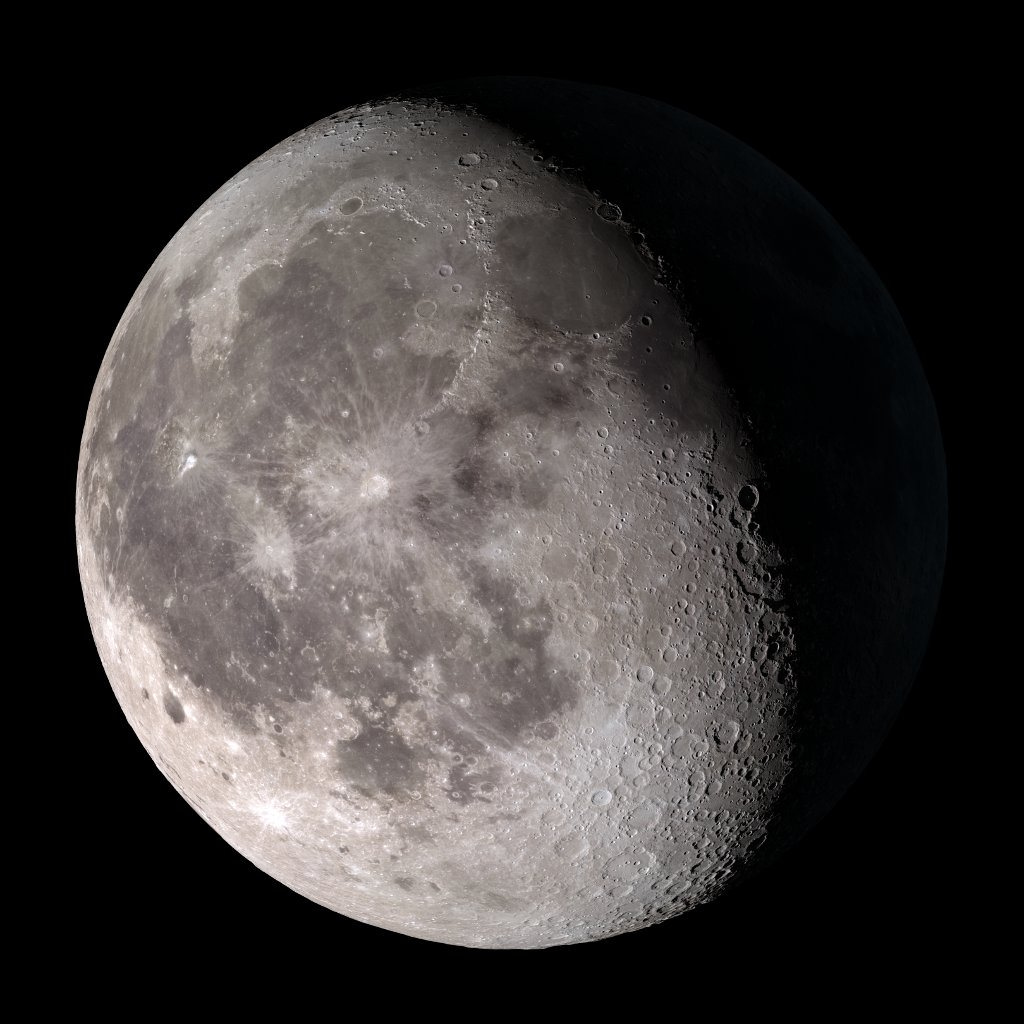
The last quarter moon continues the decrease in illumination of the lunar surface that began with its predecessor, the waning gibbous moon. The lunar surface of the last quarter moon appears as half-lit, at 50 percent. In the Northern Hemisphere, the left side appears as the illuminated half. In the Southern Hemisphere, the right side is lit.
The last quarter moon makes its third appearance in 2015 on Friday, March 13th, occurring at 1:48 p.m. Eastern Daylight Time, or 5:48 p.m. Coordinated Universal Time.
The last quarter moon claims two of the three Friday the 13ths that occur in 2015. The year's first Friday the 13th happened in February and coincided with the year's second appearance of the last quarter moon. The year's third and last Friday the 13th shows up in November and claims the waxing crescent moon as the day's lunar phase.
The last quarter moon yields to its successor, the waning crescent moon, on Sunday, March 15.

"The Last Quarter Moon rises at midnight"; source Museums Victoria; photo by Museums Victoria 3D animator Mats Bjorklund (Swedish-Australian singer-songwriter MatsB; former Museums Victoria science animator; owner, director and animator at Magipics): Museums Victoria's Little Science Teacher Support Materials, CC BY 4.0 International, via Museums Victoria, CC BY 4.0 International, via Museums Victoria

Acknowledgment
My special thanks to talented artists and photographers/concerned organizations who make their fine images available on the internet.

Image credits:
Last Quarter Moon; Monday, March 10, 1969, 21:50:00 GMT (Greenwich Mean Time), image by Apollo 9 Crew; NASA ID AS09-23-3500: Earth Science and Remote Sensing Unit, NASA Johnson Space Center, NASA does not maintain a copyright, via Gateway to Astronaut Photography of Earth @ http://eol.jsc.nasa.gov/SearchPhotos/photo.pl?mission=AS09&roll=23&frame=3500
"The Last Quarter Moon rises at midnight"; source Museums Victoria; photo by Museums Victoria 3D animator Mats Bjorklund (Swedish-Australian singer-songwriter MatsB; former Museums Victoria science animator; owner, director and animator at Magipics): Museums Victoria's Little Science Teacher Support Materials, CC BY 4.0 International, via Museums Victoria @ https://museumsvictoria.com.au/learning/little-science/teacher-support-materials/phases-of-the-moon/; former URL @ http://museumvictoria.com.au/education/learning-lab/little-science/teacher-guide/phases-of-the-moon/

For further information:
Byrd, Deborah. “Understanding last quarter moon.” EarthSky > Tonight > Moon Phases. July 10, 2012.
Available @ http://earthsky.org/moon-phases/last-quarter
Enevoldsen, Alide. “Skies Over West Seattle, March 2015: Seeing stars (and planets); lunar eclipse ahead.” West Seattle Blog. March 8, 2015.
Available @ http://westseattleblog.com/2015/03/skies-over-west-seattle-march-2015-seeing-stars-and-planets-lunar-eclipse-ahead/
Fuller, David. “Moon Maps.”Eyes on the Sky > Moon.
Available @ http://www.eyesonthesky.com/Moon.aspx
Museums Victoria. "Phases of the Moon." Little Science > Teacher Support Materials.
Available @ https://museumsvictoria.com.au/learning/little-science/teacher-support-materials/phases-of-the-moon/
“Names and images of the 8 moon phases.” MoonPhases.info > Moon Phases.
Available @ http://www.moonphases.info/moon_phases.html
"What Is the Moon Doing?" Astronomy Group / University of St. Andrews > Fiona Vincent > What's in the sky? > Moon general.
Available @ http://star-www.st-and.ac.uk/~fv/sky/moon-general.html


Uranus the Blue Green Ice Giant: Sideways Seventh Planet From the Sun


Summary: Blue green ice giant Uranus has a sideways rotation and is visible to the naked eye despite its orbital placement as the seventh planet from the sun.


view of Uranus in 1986 from Voyager 2, first spacecraft to visit the sideways planet's neighborhood; image addition date 1986-12-18; image credit NASA/JPL-Caltech: "PIA18182 Uranus as seen by NASA's Voyager 2," May be used for any purpose without prior permission, via NASA JPL Photojournal

German-born English astronomer and musician Sir William Herschel (Nov. 15, 1738-Aug. 25, 1822) is credited with the official discovery of the planet Uranus on March 13, 1781. William noticed the planet, which he at first suspected to be either a comet or a star, while scanning the skies through his customized, homemade 7-foot reflecting telescope in his back yard in Bath, in South West England.
By 1783, William had designated his puzzling discovery as a planet and named it Georgium Sidus ("George's Star") to honor the reigning king, George III (June 4, 1738-Jan. 9, 1848). Other suggestions for renaming the Georgian Planet were proposed until Uranus gained universal acceptance in 1850.
Uranus holds the honor of being the first planet to be discovered by a telescope and, therefore, the first planet to be discovered in modern times.
German astronomer Johann Elert Bode (Jan. 19, 1747-Nov. 23, 1826) proposed Uranus as the planet's name. He was impassioned by Uranus' discovery to uncover 17th century sightings of Uranus, mistakenly recorded as a star, by poring through old star charts.
English astronomer John Flamsteed (Aug. 19, 1646-Dec. 31, 1719) is credited, thanks to Johann Bode's diligent research, with the first official recorded sighting of Uranus. On Dec. 23, 1690, the blue-green ice giant was mistakenly noted and named as a star, 34 Tauri, in the constellation Taurus the Bull. Flamsteed was appointed as the first Astronomer Royal in 1675 with the founding of the Royal Observatory Greenwich.
Actually, Uranus is visible without optical aids against a backdrop of darkened skies. The dimly-lit planet is not as easy to spot as the five brightest planets, known as the naked eye planets: Mercury, Venus, Mars, Jupiter and Saturn. The earliest naked eye sighting of Uranus, mistaken as a star in the constellation Virgo, may have been made by Greek astronomer and mathematician Hipparchus of Nicaea (ca. 190-ca. 120 BCE) in 128 BCE.

Six narrow-angle camera (NAC) color images derived from 60 frames taken at a distance of more than 4 billion miles from Earth by Voyager 1 represent the spacecraft's "first ever 'portrait' of the solar system"; the mosaic presents six of the solar system's planets: (top left to right) Venus, Earth and Jupiter and (bottom left to right) Saturn, Uranus and Neptune; color images result from the recombination of images initially taken through violet, blue and green color filters; Earth's coincidentally lying in the center of scattered light rays resulting from the image's closeness to the sun explains Earth's apparent surround by a band of light; image addition date 1996-09-13; image credit NASA/JPL: "PIA00453: Solar System Portrait -- Views of 6 Planets," May be used for any purpose without prior permission, via NASA JPL Photojournal

Uranus orbits the sun from an average distance of 1.8 billion (1,800,000,000) miles, which equates to 2.9 billion (2,900,000,000) kilometers. In Uranian time, one year equals about 84 Earth years, the amount of time for Uranus to complete a full orbit around the sun.
One day lasts about 17 hours, the amount of time required for Uranus to make a complete rotation on its axis. Uranus joins Venus as the only two planets in the solar system with a retrograde, or backward, rotation. While the other planets rotate from west to east, Uranus and Venus spin from east to west.
Uranus' east-to-west rotation actually is described better as a south-to-north spin. Uranus is known as the sideways planet because its geographic and magnetic north and south poles display such dramatic misalignment that Uranus virtually spins on its sides. Uranus' axial tilt, the angle between its rotational axis and its orbital axis, registers at a lopsided 98 degrees, in comparison to the Earth's tilt of 23.5 degrees.
The reason for Uranus' uniquely skewered magnetic field geography is unknown but is routinely explained as stemming from an early interplanetary collision with an earth-sized protoplanet. An alternative hypothesis proffered by the Observatoire de Paris in 2009 suggests a collision-free scenario prompted by ejection of a larger moon, responsible for the tilt early in Uranus' formation, during planetary migrations as the planets settled into their current orbits.
Uranus joins its neighbor, Neptune, as the solar system's only ice giants, giant planets primarily composed of elements heavier than helium and hydrogen and with ices as their constituent compounds during planetary formation. Methane gas in Uranus' atmosphere causes the planet's brilliant blue-green color.
Uranus belongs to a quartet of giant planets encircled by rings. Along with Uranus, the Jovian ringed planets are composed of Neptune and the two gas giants, Jupiter and Saturn.
Uranus remains a tantalizing mystery, with many secrets to glean and few facts to know with certainty. Launched Sept. 5, 1977, with a focus on Jupiter and Saturn, Voyager 1 was the first spacecraft to photograph Uranus. Its planetary images were taken through a narrow angle camera with 1500 mm focal length and with violet, blue and green filters. Earthlings received their first close-up view of Uranus with Voyager 2's flyby visit Jan. 24, 1986, at a closest approach of 50,600 miles (81,500 kilometers).
NASA Hubble Space Telescope (HST) has been sending intriguing images of the seventh planet since its first photographs taken Aug. 14, 1998. Hubble images taken in 2005 surprised scientists by revealing a pair of hitherto unknown dusty rings.

edge-on views of Uranian rings August 2003, August 2005 and Tuesday, Aug. 14, 2007 (left to right); image credit NASA, ESA and M. Showalter (SETI Institute): "Going, Going, Gone: Hubble Captures Uranus's Rings on Edge," NASA news release Aug. 23, 2007, No claim to copyright is being asserted by STScI and material on this site may be freely used as in the public domain in accordance with NASA's contract, via NASA Hubble Space Telescope

Acknowledgment
My special thanks to talented artists and photographers/concerned organizations who make their fine images available on the internet.

Image credits:
view of Uranus in 1986 from Voyager 2, first spacecraft to visit the sideways planet's neighborhood; image addition date 1986-12-18; image credit NASA/JPL-Caltech: "PIA18182 Uranus as seen by NASA's Voyager 2," May be used for any purpose without prior permission, via NASA JPL Photojournal @ https://photojournal.jpl.nasa.gov/catalog/PIA18182
Six narrow-angle camera (NAC) color images derived from 60 frames taken at a distance of more than 4 billion miles from Earth by Voyager 1 represent the spacecraft's "first ever 'portrait' of the solar system"; the mosaic presents six of the solar system's planets: (top left to right) Venus, Earth and Jupiter and (bottom left to right) Saturn, Uranus and Neptune; color images result from the recombination of images initially taken through violet, blue and green color filters; Earth's coincidentally lying in the center of scattered light rays resulting from the image's closeness to the sun explains Earth's apparent surround by a band of light; image addition date 1996-09-13; image credit NASA/JPL: "PIA00453: Solar System Portrait -- Views of 6 Planets," May be used for any purpose without prior permission, via NASA JPL Photojournal @ https://photojournal.jpl.nasa.gov/catalog/PIA00453
edge-on views of Uranian rings August 2003, August 2005 and Tuesday, Aug. 14, 2007 (left to right); image credit NASA, ESA and M. Showalter (SETI Institute): "Going, Going, Gone: Hubble Captures Uranus's Rings on Edge," NASA news release Aug. 23, 2007, No claim to copyright is being asserted by STScI and material on this site may be freely used as in the public domain in accordance with NASA's contract, via NASA Hubble Space Telescope @ https://hubblesite.org/contents/news-releases/2007/news-2007-32.html;
August 2003 image @ https://hubblesite.org/contents/media/images/2007/32/2179-Image.html; August 2005 image @ https://hubblesite.org/contents/media/images/2007/32/2177-Image.html; Tuesday, Aug. 14, 2007, image @ https://hubblesite.org/contents/media/images/2007/32/2180-Image.html

For further information:
Boué, Gwenaël, and Jacques Laskar. "A Collisionless Scenario for Uranus Tilting." arXiv.org > Abstracts > Astrophysics > Earth and Planetary Astrophysics.  Version 2: Feb. 9, 2010.
Available via arXiv @ http://arxiv.org/pdf/0912.0181v2.pdf
Brown, Dwayne, George Deutsch, and Ray Villard. "NASA's Hubble Discovers New Rings and Moons Around Uranus." Hubblesite > Newscenter > News Release Archive. Dec. 22, 2005.
Available @ http://hubblesite.org/newscenter/archive/releases/2005/33/text/
Forbes, Eric G. "Early Astronomical Researches of John Flamsteed." Journal of the History of Astronomy, Vol. 7, No. 2 (June 1976): 124 - 138.
Available via SAO/NASA Astrophysics Data System @ http://adsabs.harvard.edu/full/1976JHA.....7..124F
Hunt, Garry E., and Patrick Moore. Atlas of Uranus. Cambridge UK, New York NY, Melbourne Australia: Cambridge University Press, 1989.
Jet Propulsion Laboratory. "PIA00453: Solar System Portrait -- Views of 6 Planets." NASA JPL Photojournal. Image addition date 1996-09-13. Image credit NASA/JPL.
Available via NASA JPL Photojournal @ https://photojournal.jpl.nasa.gov/catalog/PIA00453
Marriner, Derdriu. "Uranus Discovery 234 Years Ago on March 13, 1781, by Sir William Herschel." Earth and Space News. Friday, March 13, 2015.
Available @ https://earth-and-space-news.blogspot.com/2015/03/uranus-discovery-234-years-ago-on-march.html
"Target is Uranus." Jet Propulsion Laboratory > Photojournal.
Available via NASA JPL Photojournal @ http://photojournal.jpl.nasa.gov/target/Uranus
"Uranus and Neptune." NASA's Cosmos > Planets and Moons.
Available via Tufts University @ http://ase.tufts.edu/cosmos/print_chapter.asp?id=11
"Uranus: Overview." Solar System Exploration > Planets > Uranus > Overview.
Available via NASA @ http://solarsystem.nasa.gov/planets/profile.cfm?object=Uranus


Uranus Discovery 234 Years Ago on March 13, 1781, by Sir William Herschel


Summary: Friday, March 13, 2015, marks the 234th anniversary of the discovery of Uranus by Sir William Herschel.


false color image of Uranus generated by Erich Karkoschka from data taken Aug. 8, 1998, with Hubble Space Telescope's Near Infrared Camera and Multi-Object Spectrometer; credit NASA/JPL/STScI: "Hubble Finds Many Bright Clouds on Uranus," NASA image Aug. 24, 2000, May be used for any purpose without prior permission, via NASA Jet Propulsion Laboratory

March 13, 2015, which falls on a Friday, commemorates the 234th anniversary of the discovery of Uranus by Sir William Herschel on March 13, 1781, which fell on a Tuesday.
Born into a musical family in Hanover, in today's north central Germany, Friedrich Wilhelm Herschel (Nov. 15, 1738-Aug. 25, 1822) first applied his diligence and genius to music, playing at least four instruments (harpsichord, oboe, organ, violin) and composing in a variety of musical genres, including 24 symphonies. With the French occupation of Hanover in the wake of their victory on July 26, 1757, at the Battle of Hastenbeck, William, then aged 19, migrated with his older brother Heinrich Anton Jacob Herschel (November 1734-1792) to England, where he anglicized his first and second names to Frederick William.
Through his musical interests, William developed a passion for mathematics and lenses that led him to astronomy. William began building his own versions of reflecting telescopes, a mid-17th century invention.
Scientific genius Sir Isaac Newton (Dec. 25, 1642-March 20, 1726/7) generally is credited with completing the first functional reflecting telescope in 1668. Also known as a reflector, a reflecting telescope is a type of optical telescope based upon catoptrics (Greek: κάτοπτρον, katoptron, "mirror"), the branch of optics (study of light) using mirrors to gather and focus light.
By May 1773, William was an impassioned sky gazer, searching with his homemade, customized telescopes for double stars, which are star pairs seemingly in proximity in the sky, and also for planets (Ancient Greek: ἀστήρ πλανήτης, astēr planētēs, "wandering star").
With his appointment in 1766 as organist of Octagon Chapel in the resort city of Bath in England's South West county of Somerset, William had settled into a small, Georgian-style townhouse with three stories plus an attic and a basement at 19 New King Street. In the property's garden, off the basement's rear kitchen, William built a workshop for his design experiments on telescopes. William logged many hours -- with the assistance of his sister Caroline (March 16, 1750-Jan. 9, 1848) -- polishing his telescopes' mirrors, made of speculum metal, a mixture of two-thirds copper and one-third tin.
On Friday, March 13, 1981, the 200th year anniversary of William's planetary discovery, his townhouse opened as the Herschel Museum of Astronomy, under the ownership of the Herschel House Trust.
It was through a 7-foot telescope with a 6.2-inch aperture that he had made in his workshop that William espied Uranus on Tuesday, March 13, 1781. He first assumed that the celestial body was either a comet or a star. His sister Caroline took notes as he discovered his sighting.
By 1783, William accepted his discovery as a planet, which he named Georgium Sidus ("George's Star") in honor of George III (June 4, 1738-Jan. 29, 1820), whose kingly reign over Great Britain and Ireland began Oct. 25, 1760.
In 1784, French astronomer Joseph Jérôme Lefrançois de Lalande (July 11, 1732-April 4, 1807) proposed renaming the seventh planet from Earth's sun as Herschel.
Included among mythology-based names as alternatives to the Georgian Planet was Uranus, proposed in 1785 by German astronomer Johann Elert Bode (Jan. 19, 1747-Nov. 23, 1826) to conform with the patronymic chain of Jupiter as father of Mars, Saturn as father of Jupiter and Uranus as father of Saturn. The name of Uranus achieved universal acceptance in 1850 with its inclusion in The Nautical Almanac, published as a guide for celestial navigation since 1767.
In the intervening two and one-third centuries that have passed since Uranus caught William's attention, the blue-green planet continues to stand out. Uranus is honored as the first planet to be discovered by the fairly newly invented reflecting telescope, trailblazing harbinger of continual discoveries, including Neptune in 1846, on the time-space continuum. The blue-green ice giant also is the only solar system planet with the Greek form (Ancient Greek: Οὐρανός,Ouranos, "heaven, sky"), not the Roman form (Latin: Caelus), of a deity from classical mythology.

replica of telescope through which William Herschel discovered the planet Uranus, Herschel Museum of Astronomy, Bath, Somerset, South West England: Mike Young, Public Domain, via Wikimedia Commons

Acknowledgment
My special thanks to talented artists and photographers/concerned organizations who make their fine images available on the internet.

Image credits:
false color image of Uranus generated by Erich Karkoschka from data taken Aug. 8, 1998, with Hubble Space Telescope's Near Infrared Camera and Multi-Object Spectrometer; credit NASA/JPL/STScI: "Hubble Finds Many Bright Clouds on Uranus," NASA image Aug. 24, 2000, May be used for any purpose without prior permission, via NASA Jet Propulsion Laboratory @ http://www.jpl.nasa.gov/spaceimages/details.php?id=PIA02963;
"PIA02963: Hubble Finds Many Bright Clouds on Uranus," May be used for any purpose without prior permission, via NASA JPL Photojournal @ https://photojournal.jpl.nasa.gov/catalog/PIA02963
replica of telescope through which William Herschel discovered the planet Uranus, Herschel Museum of Astronomy, Bath, Somerset, South West England: Mike Young, Public Domain, via Wikimedia Commons @ http://commons.wikimedia.org/wiki/File:HerschelTelescope.jpg

For further information:
Herschel, Mr., and Dr. Watson, Jun. of Bath. "Account of a Comet. Read April 26, 1781." Philosophical Transactions of the Royal Society of London, vol. LXXI [71] (1 January 1781): 492 - 501.
Available via Wikimedia Commons @ http://commons.wikimedia.org/wiki/File:Herschel-Account_of_a_Comet.pdf
“IoE Number 443114; Nos. 18 – 19 New King Street.” Images of England.
Available @ http://www.imagesofengland.org.uk/details/default.aspx?id=443114
Marriner, Derdriu. "Uranus the Blue Green Ice Giant: Sideways Seventh Planet From the Sun." Earth and Space News. Friday, March 13, 2015.
Available @ https://earth-and-space-news.blogspot.com/2015/03/uranus-blue-green-ice-giant-sideways.html
Mullaney, James. The Herschel Objects and How to Observe Them. New York: Springer Science+Business Media, 2007.
Talcott, Richard. “The Sky This Week: March 6 – 15, 2015.” Astronomy Magazine > Observing > The Sky This Week. March 6, 2015.
Available @ http://astronomy.com/observing/sky-this-week/2015/03/march-615-2015
“Uranus: Overview.” NASA Solar System Exploration > Planets > Uranus.
Available @ http://solarsystem.nasa.gov/planets/profile.cfm?object=Uranus


Monday, March 9, 2015

Waning Gibbous Moon: Sixth Lunar Phase Still Shines Even With Lessening Light


Summary: The waning gibbous moon signals lessening light as the sixth lunar phase and appears with Antares and Saturn in March 2015.


waning gibbous moon: NASA Goddard Space Flight Center (NASA Goddard Photo and Video), CC BY 2.0 Generic, via Flickr

The waning gibbous moon signals that lunar illumination, as viewed by Earthlings, is decreasing. The waning gibbous moon presents a lunar surface that is more than one-half, or 50 percent, lighted but that is decidedly less aglow than the full illumination of its predecessor, the full moon.
Waning gibbous moon is a perfect descriptive name for this lunar phase. Waning has a definition of "decreasing." Gibbous, derived via Middle English from the Latin word gibbus ("humped"), has a definition of "convex," which describes an outwardly bowed or curved shape.
The waning gibbous moon's decreasing surface illumination, casting a humpbacked shape to the lunar outline in the skies, is clearly discernible. In this phase, the moon's angle with respect to the Earth and the sun measures between 90 and 135 degrees. Less than half of the surface visible to Earthlings is shadowed. More than half of the surface visible to Earthlings is alight.
The waning gibbous moon joins succeeding phases as heralds of decreasing lunar illumination, as viewed by Earthlings. The waning gibbous moon signifies that the moon has passed beyond the halfway point, marked by the full moon, in its orbit around the Earth.
The waning gibbous moon occupies sixth place in the moon's eight-phase monthly lunar cycle. As the sixth phase, the waning gibbous follows the full moon and precedes the Last Quarter Moon.
The eight phases are further reckoned as four primary and four intermediate phases. The waning gibbous moon numbers third in the intermediate phases.
Waning gibbous moons treat viewers with their humpbacked risings and settings. This sixth lunar phase rises after sunset and sets after sunrise. With their early morning blueness, western skies cradle the waning gibbous moon. Between sunset and midnight the waning gibbous moon rules over eastern horizons.
The waning gibbous moon makes its third appearance in 2015 on Saturday, March 7. The humpbacked waning moon reigns until the last quarter moon occurs Friday, March 13, at 1:48 p.m. Eastern Daylight Time (5:48 p.m. Coordinated Universal Time).
The waning gibbous moon's swan song in March 2015 is a stunning trio with ringed-planet Saturn and reddish star Antares. The celestial performance takes place approximately between midnight and dawn. Antares, the ruby heart of Scorpius the Scorpion constellation, shines its orange redness about 8 degrees south of the humpbacked waning moon.
Saturn glows goldenly about 2 degrees southwest of the waning gibbous moon. With its north pole tipped about 25 degrees toward the Earth, Saturn will regale even small telescope viewers with the discernible northern surface of its legendary rings.
As with all lunar phases, the waning gibbous moon offers monthly visual delights for Earthlings.
Things always "look up" (i.e., become better) simply by looking up.

"11:22 PM: Still ample light in the Antarctic summer"; waning gibbous moon at Port Lockroy, northwestern Wiencke Island, Palmer Archipelago, northwestern Antarctica; Monday, Jan. 24, 2011, 23:22:24: Liam Quinn, CC BY SA 2.0 Generic, via Flickr

Acknowledgment
My special thanks to talented artists and photographers/concerned organizations who make their fine images available on the internet.

Image credits:
waning gibbous moon: NASA Goddard Space Flight Center (NASA Goddard Photo and Video), CC BY 2.0 Generic, via Flickr @ https://www.flickr.com/photos/gsfc/15958998266/
"11:22 PM: Still ample light in the Antarctic summer"; waning gibbous moon at Port Lockroy, northwestern Wiencke Island, Palmer Archipelago, northwestern Antarctica; Monday, Jan. 24, 2011, 23:22:24: Liam Quinn, CC BY SA 2.0 Generic, via Flickr @ https://www.flickr.com/photos/liamq/6081560634/

For further information:
Gaherty, Geoff. “Night Sky: Visible Planets, Moon Phases and Events, March 2015.” SPACE.com > Skywatching. March 2, 2015.
Available @ http://www.space.com/16149-night-sky.html
“March Moon and Planet data for March 2015.” Royal Astronomical Society of New Zealand > Solar System.
Available @ http://rasnz.org.nz/SolarSys/
“Moon phase for 12 March 2015 Thursday.” Lunaf.com > Moon phases.
Available @ http://lunaf.com/english/moon-phases/lunar-calendar-2015/03/12/
Sessions, Larry. “Moon near planet Saturn, star Antares before dawn March 12.” EarthSky. March 09–March 15, 2015.
Available @ http://earthsky.org/tonight/predawn-moon-near-saturn-ruby-antares


Sunday, March 8, 2015

Cope's Gray Treefrog Habitats: Chirpy, Squeaky Weep, Fast, Harsh Trill


Summary: Eastern North American Cope's gray treefrog habitats get chirpy squeaks and fast rattles from gray-green bodies with pale eyespots and yellow underparts.


Cope's gray treefrog (Hyla chrysoscelis) camouflages well, except for flash pattern of yellow-orange patches on hind legs: Brad Michael "Bones" Glorioso, USGS National Wetlands Research Center, Public Domain, via USGS Amphibian Research and Monitoring Initiative (ARMI)

North American Cope's gray treefrog habitats amass forest, grassland and prairie distribution ranges from New Jersey through Florida, Texas, Nebraska, Iowa, Minnesota, Alberta, Wisconsin, Michigan, Ohio and West Virginia and everywhere in-between.
Cope's gray treefrogs bear their common name as a scientist's namesake and for body ground color and day-time breeding, and day-in, day-out nonbreeding, season living quarters. Their scientific name Hyla chrysoscelis (gold-spotted wood [dweller]) communicates Hylidae family membership with chorus and cricket frogs and other treefrogs and confirms characteristic, yellow thigh spots. The scientific designation delves into descriptions in 1880 by Edward Drinker Cope (July 28, 1840-April 12, 1897), American herpetologist (amphibian and reptile specialist) from Philadelphia, Pennsylvania.
Cope's gray treefrog life cycles expect fishless semi-permanent or temporary breeding ponds with bare, forested, grassy, weedy and woody edges for burrowing, foraging, hiding and sheltering.

March through August furnish Cope's gray treefrog life cycles with breeding season months despite the predatory proliferation of birds, giant waterbugs, shrews, snakes and tiger salamanders.
Large, sticky toe pads and long legs get Cope's gray treefrogs to breeding ponds more from bare, grassy, weedy ground than from gray treefrog-favored woody plants. Cope's gray treefrogs hear their calls, despite similar gray treefrog frequencies, through matched filtering for two circular tympanic-membraned eardrums and their inner-ear's amphibian and basilar papillae. Lung expirations impel air streams over vocal cords to inflate vocal sacs and initiate closed-mouth, closed-nostril advertisements, aggression against competitors, courtship, rain and release from contact.
Batrachochytrium dendrobatidis fungus, fertilizer runoff, globally warmed climate change, nonnative species, toxic pesticides, trematode fluke-induced deformities and ultraviolet radiation jeopardize North American Cope's gray treefrog habitats.

One thousand to 2,000 brown-cream-yellow 0.04- to 0.05-inch (1.1- to 1.2-millimeter) eggs in 10- to 40-egg films and 3- to 7-day hatched tadpoles keep to water.
Cope's gray treefrogs look like 1.26- to 1.49-inch (32- to 38-millimeter), herbivorous (plant-eating) fish and little-legged, long-tailed, 1.97-inch (50-millimeter) carnivores (flesh-eaters) 45 to 65 days later. The male manages axillary amplexus (armpit embrace) by maintaining forelimbs behind his mate's front legs while mounted on her back to fertilize brown-cream-yellow, sticky eggs externally. Unlike algae-, organic debris-, plant-eating tadpoles, adults need ants, beetles, caddisflies, craneflies, crickets, flies, grasshoppers, mites, mosquitoes, moths, pillbugs, sowbugs, spiders, stinkbugs, termites, wasps and worms.
North American Cope's gray treefrog habitats offer season-coldest temperatures, northward to southward, from minus 45 to 25 degrees Fahrenheit (minus 42.11 to minus 3.88 degrees Celsius).

Aspen, coastal, conifer, hardwood, highland, lowland and mixed forests, blackland prairies, coastal, forested, mixed and tall grasslands and savannahs and pine barrens promote Cope's gray treefrogs.
Lang Elliott, Carl Gerhardt and Carlos Davidson quantify 1.25- to 2.375-inch (3.18- to 6.03-centimeter) snout-vent (excrementary opening) lengths in The Frogs and Toads of North America. Adults reveal camouflage-, color-, temperature-changing black-, gray-, white-blotched, lined, spotted gray and green rough-skinned bodies, one white spot below each gold-lidded dark eye and yellow-washed underparts. Chirping, squeaky weep calls sound similar to gray treefrog aggression and releases even though rattling trills sound harsh and two times faster than gray treefrog advertisements.
Faster, harsher ground, not woody plant-level, calls and 24, not 48, chromosomes, tell Cope's gray treefrogs from gray treefrogs in North American Cope's gray treefrog habitats.

calling adult male Cope's gray treefrog (Hyla chrysoscelis); Atchafalaya Basin, south central Louisiana: Brad Michael "Bones" Glorioso, USGS National Wetlands Research Center, Public Domain, via USGS Amphibian Research and Monitoring Initiative (ARMI)

Acknowledgment
My special thanks to talented artists and photographers/concerned organizations who make their fine images available on the internet.

Image credits:
Cope's gray treefrog (Hyla chrysoscelis) camouflages well, except for flash pattern of yellow-orange patches on hind legs: Brad Michael "Bones" Glorioso, USGS National Wetlands Research Center, Public Domain, via USGS Amphibian Research and Monitoring Initiative (ARMI) @ https://armi.usgs.gov/gallery/result.php?search=Hyla+chrysoscelis
calling adult male Cope's gray treefrog (Hyla chrysoscelis); Atchafalaya Basin, south central Louisiana: Brad Michael "Bones" Glorioso, USGS National Wetlands Research Center, Public Domain, via USGS Amphibian Research and Monitoring Initiative (ARMI) @ https://armi.usgs.gov/gallery/result.php?search=Hyla+chrysoscelis

For further information:
Cope, Edward D. (Drinker). 1880. "On the Zoological Position of Texas: Hyla femoralis Daudin. . . .This is probably a subspecies, and may be distinguished by the name of chrysoscelis." Bulletin of the United States National Museum, no. 17. Washington DC: Government Printing Office.
Available via Biodiversity Heritage Library @ https://biodiversitylibrary.org/page/7529336
Elliott, Lang; Carl Gerhardt; and Carlos Davidson. 2009. The Frogs and Toads of North America: A Comprehensive Guide to Their Identification, Behavior and Calls. Boston MA; New York NY: Houghton Mifflin Harcourt.
Frost, Darrel. "Dryphytes chrysoscelis (Cope, 1880)." American Museum of Natural History > Our Research > Vertebrate Zoology > Herpetology > Amphibians Species of the World Database.
Available @ http://research.amnh.org/vz/herpetology/amphibia/index.php//Amphibia/Anura/Hylidae/Hylinae/Dryophytes/Dryophytes-chrysoscelis
"Hyla chrysoscelis Cope's gray treefrog." Page 459. In: David Burnie and Don E. Wilson. (Eds.) Smithsonian Animal: The Definitive Visual Guide. Revised and Updated. New York NY: DK Publishing, 2011.
"The 2012 USDA Plant Hardiness Zone Map." The National Gardening Association > Gardening Tools > Learning Library USDA Hardiness Zone > USDA Plant Hardiness Zone Map.
Available @ https://garden.org/nga/zipzone/2012/


Saturday, March 7, 2015

Cricket-Chirping, Side-Striped, White-Bellied Little Grass Frogs


Summary: North American little grass frog habitats get cricket-chirping, side-striped, southern coastal plain-colored, white-bellied bodies with gold-rimmed eyes.


little grass frog (Pseudacris ocularis); Big Cypress National Preserve, Collier County, Florida: Hardin Waddle/USGS National Wetlands Research Center, Public Domain, via USGS Amphibian Research and Monitoring Initiative

North American little grass frog habitats access southeastern coastal plain distribution ranges in eastern North Carolina and South Carolina, southern Georgia and panhandle and peninsular Florida and in southeasternmost Alabama and Virginia.
Little grass frogs bear their common name as North America's smallest frog, for grasslike and grassy habitats and for hylid membership in the Hylidae frog family. Their scientific name Pseudacris ocularis (false locust [with] eye [stripes]) communicates little grass frog hylid relationships with chorus frogs, cricket frogs and temperate and tropical treefrogs. Scientific designations defer to descriptions in 1801 by Louis Augustin Guillaume Bosc (Jan. 29, 1759-July 10, 1828) and François Marie Daudin (Aug. 29, 1776-Nov. 30, 1803).
Little grass frog life cycles expect grass, sedge and sphagnum moss along pond edges and in bogs, cypress swamps, roadside ditches, temporary pools and wet depressions.

January through September from Virginia to Alabama, and though December in Florida, flourish as little grass frog breeding season months despite owls, salamanders, snakes and spiders.
Sticky, tiny toe pads get little grass frogs over bare and covered ground, 4.92 feet (1.5 meters) into bushes, shrubs, trees and vines and under logs. Matched filtering hones species-specific call frequencies into species-specific frequency vibrations for dual circular tympanic-membraned eardrums and inner-ear amphibian and basilar papillae despite background and mixed-species noise. Lung expirations impel air streams over vocal cords to inflate vocal sacs and initiate closed-mouth, closed-nostril, rainstorm-triggered advertisement, anti-competitor aggression, anti-contact release, courtship and rain calls.
Batrachochytrium dendrobatidis fungus, fertilizer runoff, globally warmed climate change, nonnative species, toxic pesticides, trematode fluke-induced deformities and ultraviolet radiation jeopardize North American little grass frog habitats.

One hundred to 200-egg clutches single-laid or 25-plus-egg-clustered, and, within 3.5 to five days, gill-breathing, keel-tailed tadpoles keep to water whereas adults know land and water.
North America's littlest frogs look like herbivorous (plant-eating) fish and like little-legged, long-tailed, 0.28- to 0.35-inch (7- to 9-millimeter) carnivores (flesh-eaters) 45 to 70 days later. Axillary amplexus (armpit embrace) moves the male's forelimbs behind his mate's front legs while mounting atop her back to fertilize her sediment- and vegetation-sticking eggs externally. Unlike algae-, organic matter-eating tadpoles, adults need ants, beetles, caddisflies, craneflies, crickets, flies, grasshoppers, mites, mosquitoes, moths, pillbugs, sowbugs, spiders, springtails, stinkbugs, termites, wasps and worms.
North American little grass frog habitats offer season's coldest temperatures, northward to southward, from 0 to 30 degrees Fahrenheit (minus 17.77 to minus 1.11 degrees Celsius).

Coastal plain grass-, sedge-, sphagnum moss-filled broadleaf, conifer and mixed forests, everglades, pine flatwoods, river swamps, rocklands, sand pine scrublands and savannahs promote little grass frogs.
Lang Elliott, Carl Gerhardt and Carlos Davidson quantify 0.44- to 0.69-inch (11.11- to 17.46-centimeter) snout-vent (excrementary opening) lengths in The Frogs and Toads of North America. Adults reveal brown, reddish or tan bodies with one stripe running sideways through each snout tip, day-active, gold-rimmed, round-pupiled eye and hind-limb and with white underparts. North America's highest-pitched advertisement calls, at about 5 to 6 kiloHerz (kHz), sound like trills succeeding brief introductory notes, for one cricket-like pt-zeee chirp per second.
Crickety chirps from dark-, side-striped, tiny, white-bellied brown-red-tan bodies tell little grass frogs from other southern coastal plain anurans in North American little grass frog habitats.

A U.S. nickel affords plenty of resting space for North America's smallest frog, an adult little grass frog (Pseudacris ocularis); Big Cypress National Preserve, Collier County, Florida: Hardin Waddle/USGS National Wetlands Research Center, Public Domain, via USGS Amphibian Research and Monitoring Initiative

Acknowledgment
My special thanks to talented artists and photographers/concerned organizations who make their fine images available on the internet.

Image credits:
little grass frog (Pseudacris ocularis); Big Cypress National Preserve, Collier County, Florida: Hardin Waddle/USGS National Wetlands Research Center, Public Domain, via USGS Amphibian Research and Monitoring Initiative @ https://armi.usgs.gov/gallery/result.php?search=Pseudacris+ocularis
A U.S. nickel affords plenty of resting space for North America's smallest frog, an adult little grass frog (Pseudacris ocularis); Big Cypress National Preserve, Collier County, Florida: Hardin Waddle/USGS National Wetlands Research Center, Public Domain, via USGS Amphibian Research and Monitoring Initiative @ https://armi.usgs.gov/gallery/result.php?search=Pseudacris+ocularis

For further information:
Elliott, Lang; Carl Gerhardt; and Carlos Davidson. 2009. The Frogs and Toads of North America: A Comprehensive Guide to Their Identification, Behavior and Calls. Boston MA; New York NY: Houghton Mifflin Harcourt.
Frost, Darrel. "Pseudacris ocularis (Holbrook, 1838)." American Museum of Natural History > Our Research > Vertebrate Zoology > Herpetology > Amphibians Species of the World Database.
Available @ http://research.amnh.org/vz/herpetology/amphibia/index.php//Amphibia/Anura/Hylidae/Acridinae/Pseudacris/Pseudacris-ocularis
Holbrook, John Edwards. 1838. "Hylodes ocularis." North American Herpetology; Or, A Description of the Reptiles Inhabiting the United States. Vol. III: 79-80. Philadelphia PA: J. Dobson.
Available via Biodiversity Heritage Library @ https://biodiversitylibrary.org/page/3683066
Sonnini, C.S. (Charles-Nicolas-Sigisbert); and P.A. (Pierre André) Latreille. 1801. "La raine oculaire, Hyla ocularis." Histoire Naturelle des Reptiles, Avec Figures Dessinées d'après Nature. Tome II: 186-187. Première Partie, Quadrupèdes et Bipèdes Ovipares. Paris, France: Imprimerie de Crapelet chez Deterville, An X (September 1801-September 1802).
Available via Biodiversity Heritage Library @ https://biodiversitylibrary.org/page/3695763
Available via Internet Archive @ https://archive.org/stream/histoirenaturell02sonn#page/187/mode/1up
"The 2012 USDA Plant Hardiness Zone Map." The National Gardening Association > Gardening Tools > Learning Library USDA Hardiness Zone > USDA Plant Hardiness Zone Map.
Available @ https://garden.org/nga/zipzone/2012/


Friday, March 6, 2015

Full Moon on March 5 Is Smallest Appearance of Fifth Lunar Phase in 2015


Summary: The full moon on March 5 is a mini-moon, opposite of supermoon, with 2015's smallest appearance of the fifth lunar phase.


full moon: NASA Goddard Space Flight Center (NASA Goddard Photo and Video), CC BY 2.0 Generic, via Flickr

The full moon makes its third appearance in 2015 on Wednesday, March 4th. March's full moon will rule the skies until transitioning into the waning gibbous moon for Earthlings on Saturday, March 7th.
The full moon numbers as the fifth phase in the monthly lunar cycle of eight phases. The completely illuminated phase, as viewed by Earthlings, marks the point of the moon's opposition to the sun during the lunar orbit around the Earth. Located on the opposite side of the Earth from the sun, the full moon traces an angle of 180 degrees with respect to the sun.
In astronomy, syzygy (Ancient Greek: σύζυγος, suzugos, "yoked together") refers to the straight-line configuration of three celestial bodies. Syzygy (SIZ-eh-gee) is evinced during the full moon phase of the lunar cycle.
As the third of the moon's four primary phases, the full moon is preceded and followed by intermediate phases. The waxing gibbous moon, the second of four intermediate phases and the fourth of the lunar cycle's total of eight phases, transitions between the first quarter moon and the full moon. The waning gibbous moon, numbered as third intermediate phase and as sixth of eight total lunar phases, transitions between the full moon and the fourth primary phase, the last quarter moon.
The full moon celebrates the apex of lunar illumination, as viewed by Earthlings. The journey from new moon to full moon, midway in the lunar orbit around the Earth, heralds increasing lunar illumination for Earthlings. The trek from full moon back to the new moon signals decreasing lunar illumination for Earthlings as the moon completes its monthly lunar cycle with the waning crescent moon, the fourth and last intermediate phase and the eighth and final phase of the total cycle, and as the new cycle begins with the new moon's zero percent illumination.
On Thursday, March 5, 2015, the full moon appears as a mini-moon for those viewers sensitive to the resplendent fullness of the moon's fifth phase. The full moon appears as a mini-moon when the fifth phase seems smaller than usual, despite its full illumination as viewed by Earthlings. The position of the full moon at its greatest distance from the Earth triggers the phase's miniature appearance.
Apogee (Ancient Greek: ἀπόγειον, apógeion, “away from Earth”) is the term in astronomy for the greatest distance from the center of the Earth in an object's orbit. Lunar apogee, variant because of the moon's variable elliptical orbit, varies in distances from 251,034 to 252,712 miles (404,000 to 406,700 kilometers).
Occurring at 2:36 a.m. Eastern Standard Time (7:36 Universal Time), on March 5, full moon apogee measures 252,516 miles (406,385 kilometers) of distance between the center of the moon and the center of the Earth. A mini-moon makes its appearance within 24 hours of apogee.
A mini-moon also enjoys the synonymous nickname of micro-moon in popular culture. Astronomers refer to the mini-moon as an apogee full moon.
A mini-moon's antonym is a super-moon. In astronomy a super-moon for the fifth lunar phase is termed as full moon perigee (Ancient Greek: περί, perí, “near” + γῆ, gê, “Earth”).
Whether mini- or super-sized or in between, the full moon is a sight to see, again and again, month after month, year after year. How many full moons can a person view in a lifetime? The tally is personal for each person.

full moon over Frankfurt am Main, west central Germany; Wednesday, Oct. 8, 2014: The Freelens, CC BY ND 2.0 Generic, via Flickr

Acknowledgment
My special thanks to talented artists and photographers/concerned organizations who make their fine images available on the internet.

Image credits:
full moon: NASA Goddard Space Flight Center (NASA Goddard Photo and Video), CC BY 2.0 Generic, via Flickr @ https://www.flickr.com/photos/gsfc/15984763045/
full moon over Frankfurt am Main, west central Germany; Wednesday, Oct. 8, 2014: The Freelens, CC BY ND 2.0 Generic, via Flickr @ https://www.flickr.com/photos/ch-straub/15311247928/

For further information:
Dickinson, David. “The Mini-Moon Cometh: Catch the Smallest Full Moon of 2015 This Thursday.” Universe Today. March 3, 2015.
Available @ http://www.universetoday.com/119164/the-mini-moon-cometh-catch-the-smallest-full-moon-of-2015-this-thursday/
“Moon Phase and Libration, 2015: Visualizations by Ernie Wright.” NASA Scientific Visualization Studio > Planets and Moons. December 9, 2014.
Available @ http://svs.gsfc.nasa.gov/cgi-bin/details.cgi?aid=4236
“Supermoon – Super Moon – Super Full Moon.” Time And Date.
Available @ http://www.timeanddate.com/astronomy/moon/super-full-moon.html
Walker, John. “Lunar Perigee and Apogee Calculator.” Fourmilab Switzerland. May 5, 1997.
Available @ https://www.fourmilab.ch/earthview/pacalc.html
Walsh, Glenn A. “’Mini-Moon’: 2015’s Smallest Full Moon.” SpaceWatchtower. Thursday, March 5, 2015.
Available @ http://spacewatchtower.blogspot.com/2015/03/mini-moon-2015s-smallest-full-moon.html