Summary: Roche Crater parents four satellites on the lunar far side in the cratered terrain southwest of Mare Ingenii.
 |
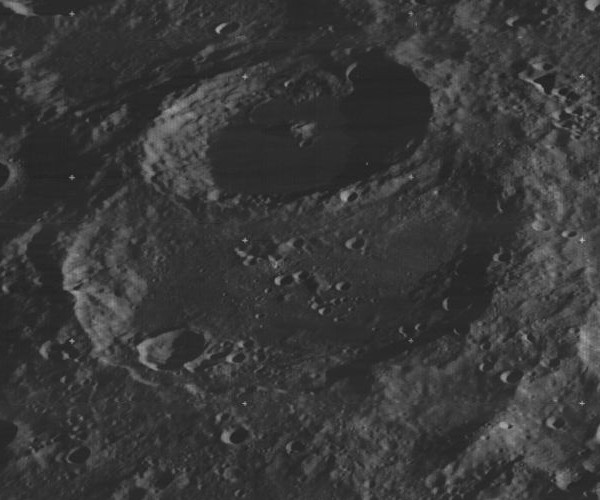
| south-facing, oblique view of Rosseland Crater, formerly known as Roche Crater system's fifth satellite, Roche U, with current Roche Crater system satellites V and W: frame 3121, image among 211 photographs obtained by Lunar Orbiter III (LO III) between Wednesday, Feb. 15, and Thursday, Feb. 23, 1967; cropped and created with UploadWizard Monday, May 23, 2016, 03:46: James Stuby (JStuby), Public Domain, via Wikimedia Commons |
The six-member Roche Crater system comprises parent crater Roche and four satellites occupying the cratered terrain to the south of Mare Ingenii in the lunar far side's southern hemisphere.
Roche Crater, the system's parent, is centered at minus 42.37 degrees south latitude, 136.54 degrees east longitude, according to the International Astronomical Union’s (IAU) Gazetteer of Planetary Nomenclature. Its northmost and southmost latitudes extend from minus 39.85 degrees south to minus 44.88 degrees south, respectively. Its eastmost and westmost longitudes end at 139.96 degrees east and 133.12 degrees east, respectively. Roche Crater's diameter spans 152.67 kilometers.
Roche B nestles on its parent's craterlet-notched, northeastern inner wall. Roche B is centered at minus 40.58 degrees south latitude, 137.79 degrees east longitude. The southern hemisphere satellite expresses its northmost and southmost latitudes at minus 40.22 degrees south and minus 40.94 degrees south, respectively. It extinguishes its eastmost and westmost longitudes at 138.27 degrees east and 137.71 degrees east, respectively. Roche B's diameter measures 21.90 kilometers.
Roche C resides to the northeast of its parent and Roche B. Roche C is centered at minus 39.13 degrees south latitude, 139.89 degrees east longitude. The southern hemisphere satellite finds its northmost and southmost latitudes at minus 38.85 degrees south and minus 39.41 degrees south, respectively. It finalizes its eastmost and westmost longitudes at 140.26 degrees east and 139.53 degrees east, respectively. Roche C has a diameter of 16.98 kilometers.
Roche V and Roche W lie to the northwest of their parent crater. Roche V neighbors to the near west of Roche W.
Roche V is centered at minus 38.98 degrees south latitude, 129.99 degrees east longitude. The southern hemisphere satellite obtains its northmost and southmost latitudes at minus 38.59 degrees south and minus 39.36 degrees south, respectively. Its eastmost and westmost longitudes occur at 130.52 degrees east and 129.46 degrees east, respectively. Roche V's diameter measures 27.81 kilometers.
Roche V's eastern neighbor, Roche W, is centered at minus 39.26 degrees south latitude, 131.26 degrees east longitude. The southern hemisphere satellite establishes its northmost and southmost latitudes at minus 38.91 degrees south and minus 39.60 degrees south, respectively. It finds its eastmost and westmost longitudes at 131.70 degrees east and 130.81 degrees east, respectively. Roche W's diameter measures 20.80 kilometers.
Roche B is positioned as the southernmost of the Roche Crater system's four satellites. Roche C qualifies as the easternmost member of the Roche Crater system. Roche V ranks as the westernmost member of the Roche Crater system. Roche V's close eastern neighbor places as the northernmost member of the Roche Crater system.
The diameters of the four satellites in the Roche Crater system range from 16.98 kilometers to 27.81 kilometers. Its diameter of 27.81 kilometers qualifies Roche V as the largest of the Roche Crater system's four satellites. Roche C's diameter of 16.98 kilometers classifies it as the smallest of the Roche Crater system's four satellites.
Rosseland Crater neighbors to the west of northwestern Roche Crater and south of satellites V and W. Rosseland formerly was designated as Roche U.
Rosseland Crater is centered at minus 40.82 degrees south latitude, 130.68 degrees east longitude. The lunar southern hemisphere-sited crater delimits its northmost and southmost latitudes at minus 39.72 degrees south and minus 41.92 degrees south, respectively. It defines its eastmost and westmost longitudes at 132.14 degrees east and 129.25 degrees east, respectively. Rosseland Crater's diameter spans 67.66 kilometers.
The Roche Crater system occupies the cratered terrain between Mare Ingenii, to the system's east, and Mare Australe, to the system's west. Mare Australe's sprawl across the moon's southeastern limb attains dual status as far side and near side resident for the lunar mare (Latin: mare, "sea"; plural, maria, "seas"). Contrastingly, Mare Ingenii confines its territory to the lunar far side.
Mare Ingenii (Sea of Cleverness) is centered at minus 33.25 degrees south latitude, 164.83 degrees east longitude. The southern hemisphere-sited dark, basaltic plain's northmost and southmost latitudes stretch from minus 28.54 degrees south to minus 37.42 degrees south, respectively. Its eastmost and westmost longitudes touch 169.85 degrees east and 158.55 degrees east, respectively. Mare Ingenii's diameter spans 282.20 kilometers.
Mare Australe (Southern Sea) is centered at minus 47.77 degrees south latitude, 91.99 degrees east longitude. The southern hemisphere-sited lunar mare's northmost and southmost latitudes reach minus 31.84 degrees south and minus 64.20 degrees south, respectively. It records eastmost and westmost longitudes of 113.36 degrees east and 70.43 degrees east, respectively. Mare Australe's diameter spans 996.84 kilometers.
The Roche Crater system memorializes 19th-century French astronomer, celestial mechanics specialist, mathematician and meteorologist Édouard Albert Roche (Oct. 17, 1820-April 27, 1883). The system's parent crater received official approval by the International Astronomical Union in 1970. The organization’s XIVth (14th) General Assembly was held in 1970 from Tuesday, Aug. 18, to Thursday, Aug. 27. The designations of the system's four satellites were adopted in 2006. The IAU's XXVIth (26th) General Assembly took place in 2006, from Monday, Aug. 14, to Friday, Aug. 25, in Prague, Czech Republic.
The Roche Crater system remembers 19th-century French astronomer, celestial mechanics specialist, mathematician and meteorologist Édouard Albert Roche (Oct. 17, 1820-April 27, 1883). The International Astronomical Union officially adopted Roche Crater’s name in 1970. The organization’s XIVth (14th) General Assembly was held in 1970 from Tuesday, Aug. 18, to Thursday, Aug. 27, in Brighton, United Kingdom. The organization’s XIVth (14th) General Assembly was held in 1970 from Tuesday, Aug. 18, to Thursday, Aug. 27, in the United Kingdom's East Sussex seaside town of Brighton.
Official approval of the names of the Roche Crater system's four satellites occurred in 2006. The IAU's XXVIth (26th) General Assembly was held in Prague, Czech Republic, in 2006 from Monday, Aug. 14, to Friday, Aug. 25.
 |
| Lunar Aeronautical Chart (LAC) 118 presents the Roche Crater system's parent and four satellites (lower left); image credit NASA/GSFC/ASU: via USGS Astrogeology Science Center / Gazetteer of Planetary Nomenclature |
Acknowledgment
My special thanks to talented artists and photographers/concerned organizations who make their fine images available on the internet.
Dedication
Dedication
This post is dedicated to the memory of our beloved blue-eyed brother, Charles, who guided the creation of the Met Opera and Astronomy posts on Earth and Space News. We memorialized our brother in "Our Beloved Blue-Eyed Brother, Charles, With Whom We Are Well Pleased," published on Earth and Space News on Thursday, Nov. 18, 2021, an anniversary of our beloved father's death.
Image credits:
Image credits:
south-facing, oblique view of Rosseland Crater, formerly known as Roche Crater system's fifth satellite, Roche U, with current Roche Crater system satellites V and W: frame 3121, image among 211 photographs obtained by Lunar Orbiter III (LO III) between Wednesday, Feb. 15, and Thursday, Feb. 23, 1967; cropped and created with UploadWizard Monday, May 23, 2016, 03:46: James Stuby (JStuby), Public Domain, via Wikimedia Commons @ https://commons.wikimedia.org/wiki/File:Rosseland_crater_3121_med.jpg; via Lunar and Planetary Institute (LPI) Resources @ https://www.lpi.usra.edu/resources/lunarorbiter/frame/?3121 (frame URL); via Lunar and Planetary Institute (LPI) Resources @ https://www.lpi.usra.edu/resources/lunarorbiter/mission/?3 (gallery URL)
Lunar Aeronautical Chart (LAC) 118 presents the Roche Crater system's parent and four satellites (lower left); image credit NASA/GSFC/ASU: via USGS Astrogeology Science Center / Gazetteer of Planetary Nomenclature @ https://asc-planetarynames-data.s3.us-west-2.amazonaws.com/Lunar/lac_118_wac.pdf (image URL); https://planetarynames.wr.usgs.gov/Feature/5166 (feature URL)
For further information:
For further information:
Bussey, Ben; and Paul Spudis. The Clementine Atlas of the Moon. Revised and updated edition. First published 2004. Cambridge UK; Cambridge MA: Cambridge University Press, 2012.
Available via Dokumen.PUB @ https://dokumen.pub/qdownload/the-clementine-atlas-of-the-moon-9780521141017-052114101x.html
Available via Dokumen.PUB @ https://dokumen.pub/qdownload/the-clementine-atlas-of-the-moon-9780521141017-052114101x.html
De Jager, C. (Cornelius) ; and A. (Arnost) Jappel, eds. XIVth General Assembly -- Transactions of the IAU Vol. XIV B Proceedings of the 14th General Assembly Brighton, United Kingdom, August 18-27, 1970. Washington DC: Association of Universities for Research in Astronomy, Jan. 1, 1971.
Available @ https://www.iau.org/publications/iau/transactions_b/
Available @ https://www.iau.org/publications/iau/transactions_b/
International Astronomical Union. “Mare Australe.” USGS Astrogeology Science Center > Gazetteer of Planetary Nomenclature. Last updated Oct 18, 2010 12:00 PM.
Available @ https://planetarynames.wr.usgs.gov/Feature/3665
Available @ https://planetarynames.wr.usgs.gov/Feature/3665
International Astronomical Union. “Mare Ingenii.” USGS Astrogeology Science Center > Gazetteer of Planetary Nomenclature. Last updated Oct 18, 2010 12:00 PM.
Available @ https://planetarynames.wr.usgs.gov/Feature/3679
Available @ https://planetarynames.wr.usgs.gov/Feature/3679
International Astronomical Union (IAU) / U.S. Geological Survey (USGS) Gazetteer of Planetary Nomenclature. “Roche.” USGS Astrogeology Science Center > Gazetteer of Planetary Nomenclature > Nomenclature > The Moon. Last updated Oct 18, 2010 12:00 PM.
Available @ https://planetarynames.wr.usgs.gov/Feature/5166
Available @ https://planetarynames.wr.usgs.gov/Feature/5166
International Astronomical Union (IAU) / U.S. Geological Survey (USGS) Gazetteer of Planetary Nomenclature. “Roche B.” USGS Astrogeology Science Center > Gazetteer of Planetary Nomenclature > Nomenclature > The Moon. Last updated Oct 18, 2010 12:00 PM.
Available @ https://planetarynames.wr.usgs.gov/Feature/12647
Available @ https://planetarynames.wr.usgs.gov/Feature/12647
International Astronomical Union (IAU) / U.S. Geological Survey (USGS) Gazetteer of Planetary Nomenclature. “Roche C.” USGS Astrogeology Science Center > Gazetteer of Planetary Nomenclature > Nomenclature > The Moon. Last updated Oct 18, 2010 12:00 PM.
Available @ https://planetarynames.wr.usgs.gov/Feature/12648
Available @ https://planetarynames.wr.usgs.gov/Feature/12648
International Astronomical Union (IAU) / U.S. Geological Survey (USGS) Gazetteer of Planetary Nomenclature. “Roche U.” USGS Astrogeology Science Center > Gazetteer of Planetary Nomenclature > Nomenclature > The Moon. Last updated Oct 18, 2010 12:00 PM.
Available @ https://planetarynames.wr.usgs.gov/Feature/12649
Available @ https://planetarynames.wr.usgs.gov/Feature/12649
International Astronomical Union (IAU) / U.S. Geological Survey (USGS) Gazetteer of Planetary Nomenclature. “Roche V.” USGS Astrogeology Science Center > Gazetteer of Planetary Nomenclature > Nomenclature > The Moon. Last updated Oct 18, 2010 12:00 PM.
Available @ https://planetarynames.wr.usgs.gov/Feature/12650
Available @ https://planetarynames.wr.usgs.gov/Feature/12650
International Astronomical Union (IAU) / U.S. Geological Survey (USGS) Gazetteer of Planetary Nomenclature. “Roche W.” USGS Astrogeology Science Center > Gazetteer of Planetary Nomenclature > Nomenclature > The Moon. Last updated Oct 18, 2010 12:00 PM.
Available @ https://planetarynames.wr.usgs.gov/Feature/12651
Available @ https://planetarynames.wr.usgs.gov/Feature/12651
International Astronomical Union (IAU) / U.S. Geological Survey (USGS) Gazetteer of Planetary Nomenclature. “Rosseland.” USGS Astrogeology Science Center > Gazetteer of Planetary Nomenclature > Nomenclature > The Moon. Last updated Oct 18, 2010 12:00 PM.
Available @ https://planetarynames.wr.usgs.gov/Feature/5196
Available @ https://planetarynames.wr.usgs.gov/Feature/5196
Marriner, Derdriu. "Far Side Roche Crater Honors 19th-Century French Astronomer Édouard Roche." Earth and Space News. Wednesday, Dec. 11, 2024.
Available @
Available @
Marriner, Derdriu. "Nine Craters Honor Phobos Finder's Wife and Eight Mars Scientists." Earth and Space News. Wednesday, Nov. 20, 2024.
Available @
Available @
The Moon Wiki. “Mare Australe.” The Moon > Lunar Features Alphabetically > A Nomenclature.
Available @ https://the-moon.us/wiki/Mare_Australe
Available @ https://the-moon.us/wiki/Mare_Australe
The Moon Wiki. “Mare Ingenii.” The Moon > Lunar Features Alphabetically > I Nomenclature.
Available @ https://the-moon.us/wiki/Mare_Ingenii
Available @ https://the-moon.us/wiki/Mare_Ingenii
The Moon Wiki. “Roche.” The Moon > Lunar Features Alphabetically > R Nomenclature.
Available @ http://the-moon.us/wiki/Roche
Available @ http://the-moon.us/wiki/Roche
The Moon Wiki. “Rosseland.” The Moon > Lunar Features Alphabetically > R Nomenclature.
Available @ http://the-moon.us/wiki/Rosseland
Available @ http://the-moon.us/wiki/Rosseland
Ostrach, Lillian. "Oblong Roche V." ASU (Arizona State University) SESE (School of Earth and Space Exploration) LROC (Lunar Reconnaissance Orbiter Camera) > Posts > 348. Dec. 6, 2011.
Available @ http://lroc.sese.asu.edu/posts/348
Available @ http://lroc.sese.asu.edu/posts/348
Parsons, Alex; Inkleby. "Mare Australe (Moon) 'Southern Sea.'" We Name the Stars > Moon > Feature Type: Mare > Features Associated With Mare: Mare Ingenii.
Available via We Name the Stars @ https://wenamethestars.inkleby.com/feature/3665
Available via We Name the Stars @ https://wenamethestars.inkleby.com/feature/3665
Parsons, Alex; Inkleby. "Mare Ingenii (Moon) 'Sea of Cleverness.'" We Name the Stars > Moon > Feature Type: Mare > Features Associated With Mare: Mare Ingenii.
Available via We Name the Stars @ https://wenamethestars.inkleby.com/feature/3679
Available via We Name the Stars @ https://wenamethestars.inkleby.com/feature/3679
Parsons, Alex; Inkleby. "Roche (Moon) Named after Édouard Albert Roche -- French astronomer (1820-1883)." We Name the Stars > Moon > Feature Type: Crater > Features Associated With Crater: Crater Roche.
Available via We Name the Stars @ https://wenamethestars.inkleby.com/feature/51666
Available via We Name the Stars @ https://wenamethestars.inkleby.com/feature/51666
Parsons, Alex; Inkleby. "Rosseland (Moon) Named after Svein Rosseland -- Norwegian astrophysicist (1894-1985)." We Name the Stars > Moon > Feature Type: Crater > Features Associated With Crater: Crater Rosseland.
Available via We Name the Stars @ https://wenamethestars.inkleby.com/feature/5196
Available via We Name the Stars @ https://wenamethestars.inkleby.com/feature/5196
van der Hucht, Karel, ed. XXVIth General Assembly Transactions of the IAU Vol. XXVI B Proceedings of the 26th General Assembly Prague, Czech Republic, August 14-25, 2006. Cambridge UK: Cambridge University Press, Dec. 30, 2008. Available @ https://www.iau.org/publications/iau/transactions_b/